
Second Battle of Ypres 1915: Gas, Crisis and the Fight to Hold the Salient
↓ Plan a private battlefield visit
The Second Battle of Ypres began on 22 April 1915 with the first large-scale successful use of poison gas on the Western Front. German troops released chlorine from cylinders north of Ypres, creating a greenish-yellow cloud that drifted into French colonial positions. The attack opened a dangerous gap in the Allied line and forced Canadian troops on the exposed flank into some of their first major fighting of the war.
The battle lasted more than a month. Gas was only the opening shock. What followed were repeated attacks, counter-attacks, artillery bombardments and costly fighting at places such as Kitcheners’ Wood, St Julien, Frezenberg and Bellewaarde. By the end, the Allies still held Ypres, but the Salient had been compressed and tens of thousands of men had been killed, wounded or gassed.
Second Battle of Ypres key facts
- Dates: 22 April to 25 May 1915.
- Opening event: German chlorine-gas attack north of Ypres.
- Why it matters: first effective large-scale gas attack on the Western Front.
- Major sectors: Langemark, St Julien, Kitcheners’ Wood, Frezenberg and Bellewaarde.
- Canadian significance: the 1st Canadian Division helped hold the exposed Allied flank and fought major counter-attacks.
- Sites to visit today: Langemark area, Brooding Soldier at St Julien, Essex Farm, Kitcheners’ Wood area and the Menin Gate.
Why Ypres was still exposed in spring 1915
The First Battle of Ypres in late 1914 had fixed a front line that curved around the town. The Allies held Ypres and a bulge of ground east of it, but German forces occupied commanding positions around the Salient. The front was difficult to defend because roads and supply lines entered a zone under observation and artillery fire.
By April 1915 the war had settled into trenches, but neither side had solved the problem of breaking a defended front. Machine guns, wire and artillery made frontal attacks extremely costly. The Germans experimented with a new method: releasing chlorine gas from cylinders and letting the wind carry it towards enemy trenches.
22 April 1915: the gas cloud
The attack depended on weather. Gas cylinders had been installed along the German front north of Ypres. A favourable wind was needed to carry the chlorine towards Allied positions. Canadian official history records that the Germans were prepared to attack earlier on 22 April but postponed because there was no wind.
Later that afternoon the conditions changed. Chlorine was released along a broad front opposite French troops, including North African formations. The gas formed a dense cloud moving across the battlefield. Chlorine attacks the respiratory system and reacts with moisture in the eyes, throat and lungs. Men caught in concentrated gas experienced choking, coughing, chest pain and suffocation.
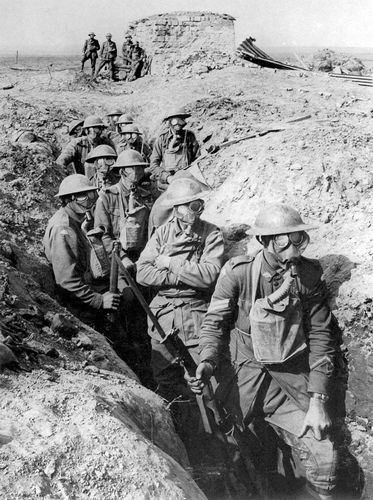
There was no mature gas-protection system. Soldiers had not been issued the later respirators associated with the chemical war. Improvised measures appeared quickly, including cloth held over the mouth and nose. The famous advice to use urine to dampen cloth has become part of popular memory, but it should not distract from the essential point: men faced a new weapon with almost no adequate protection.
The gap in the Allied line
The gas attack caused severe casualties and forced survivors out of contaminated positions. A gap opened in the Allied front north of Ypres. The situation was dangerous because a rapid German exploitation might have pushed towards the canal crossings and threatened the rear of the Salient.
Why the Germans did not achieve a decisive breakthrough remains debated. The gas attack had created an opportunity, but the attackers had limited reserves immediately available to exploit a weapon whose effects and operational possibilities were still new. Allied units also reacted quickly enough to slow the advance.
The 1st Canadian Division held positions on the flank of the broken French line. The Canadians suddenly found their left exposed. Battalions were moved, counter-attacks ordered and artillery redeployed under confusing conditions. This was not a clean defensive plan executed from a map. It was crisis management during darkness, shellfire and incomplete information.
Kitcheners’ Wood: a costly Canadian counter-attack
One of the best-known actions took place at Kitcheners’ Wood. Canadian battalions, including the 10th and 16th Battalions, were ordered forward in the night of 22–23 April. The objective was to recover ground and prevent the German advance from widening the rupture.
The attack became famous for its determination and cost. Troops advanced in darkness across open ground, encountered hedges and obstacles, and reached the wood. The action helped stabilise the situation but produced severe casualties. For Canadian memory, Kitcheners’ Wood became an early example of battlefield sacrifice before the later national narratives of the Somme and Vimy Ridge.
Today the site is farmland and road rather than a preserved trench park. This is a useful reminder that most First World War battlefields were returned to civilian life. Understanding such a site requires maps, photographs and explanation of where the wood, trenches and approach routes lay.
St Julien and the Brooding Soldier
The Canadian position continued to be attacked. St Julien became another focal point. Canadian troops were forced back as pressure increased, and the battle involved repeated local actions rather than one single front-line collapse.
Today the Canadian memorial at St Julien, commonly called the Brooding Soldier, is one of the most distinctive memorials in Flanders. A bowed Canadian soldier stands on a tall stone shaft, facing the direction from which the gas attack came. The design is deliberately restrained. It commemorates Canadian participation in the 1915 fighting rather than one individual.
Stand there and look across the flat fields. The memorial makes more sense if you picture the gas cloud moving through low ground and the emergency movements of units trying to hold an improvised line.
Canadian Flanders Fields Tour
Stand on the ground where Canada's Ypres story began
Follow the fighting of April 1915 from St Julien and the gas attack to Essex Farm, the Brooding Soldier and the wider Canadian story across the Ypres Salient.
Follow Canada's Story in Flanders Fields
Private Canadian-focused battlefield tour from Bruges or Ypres
Frezenberg and the battle for the reduced Salient
The fighting did not end after the first days. In early May German attacks continued around Frezenberg and other parts of the Salient. The Allies progressively withdrew to a shorter defensive line closer to Ypres. This reduced the exposed bulge but gave up ground east of the city.
The battle became a test of endurance. Artillery bombardment destroyed trenches faster than they could be repaired. Units arriving as reinforcements could be thrown into confused positions with little time to understand the ground. Casualty figures grew through shellfire as much as through gas.
Bellewaarde and the later gas attacks
Gas was used again during the battle. By late May the shock of the first attack had become part of a new chemical arms race. The British and French rapidly developed protective equipment and their own chemical weapons programmes. Gas would never again produce exactly the same surprise as on 22 April, but it remained a feared and increasingly sophisticated weapon throughout the war.
The Battle of Bellewaarde on 24–25 May is generally treated as the final major phase of Second Ypres. German attacks reduced the Allied positions further, but Ypres itself did not fall.
Was this the first gas attack of the First World War?
No, and this distinction is important for accurate historical writing. Chemical agents had been attempted earlier. German forces used tear-gas shells on the Eastern Front, including at Bolimów in January 1915, but cold conditions reduced their effect. The Ypres attack on 22 April was the first large-scale use of chlorine gas that achieved major battlefield results on the Western Front.
Calling it simply “the first gas attack in history” is therefore too broad. Calling it the first effective large-scale poison-gas attack on the Western Front is more precise.
What chlorine gas actually did
Popular descriptions sometimes make the gas sound like a mysterious cloud that killed instantly. Its effects depended on concentration and exposure. Chlorine is heavier than air and could gather in low ground or trenches. It reacts with moisture in the respiratory tract, damaging tissue and making breathing increasingly difficult.
Survivors could suffer prolonged respiratory problems. The psychological effect was also significant. A normal artillery barrage gave men at least some idea of where danger was coming from. Gas could drift silently, remain in low areas and force soldiers to wear uncomfortable protection while carrying out normal tasks.
John McCrae and Essex Farm
Canadian doctor John McCrae served with artillery during the Second Battle of Ypres. Near the canal north of the town, medical facilities treated casualties from the fighting. McCrae’s friend Lieutenant Alexis Helmer was killed on 2 May 1915. McCrae wrote In Flanders Fields in the days that followed.
Essex Farm is now associated with the poem, but the site should be understood as part of the casualty-evacuation system. The surviving shelters and cemetery show how closely medical care, death and burial sat beside military traffic routes.
How the battle changed chemical warfare
The Allied response was immediate. Primitive protective pads gave way to increasingly effective respirators. Chemical-warning systems developed. Both sides introduced new agents, including phosgene and mustard gas. Gas shells eventually became more flexible than cylinder releases because artillery did not depend on the wind in the same way.
Gas caused fewer deaths than artillery and conventional small-arms fire, but its cultural impact was enormous. It seemed to symbolise industrialised warfare: invisible chemistry turned into a battlefield weapon. Soldiers feared the possibility of damaged lungs, blindness and contaminated terrain.
Casualties and why totals vary
Casualty totals for large First World War battles vary depending on the dates, armies and categories included. Your live page previously used approximate totals of 59,000 British and Commonwealth casualties, 10,000 French and 35,000 German. Those figures are useful as a rough scale but should not be treated as mathematically exact.
For visitors, the more important conclusion is that Second Ypres was a major battle lasting over a month. The first gas cloud is the most famous episode, but artillery, infantry attacks and repeated defensive crises produced the majority of the battle’s experience.
What changed after Second Ypres?
The Allies retained Ypres but held a smaller Salient. The town itself became increasingly difficult to inhabit and supply. The battle also accelerated the transformation of Canadian military identity. Units that had arrived on the Western Front only months earlier were suddenly associated with one of the most dramatic defensive battles of 1915.
For Germany, the attack demonstrated the possibilities and limitations of gas. It could create local collapse, but a new weapon still needed reserves, artillery, infantry and logistics to convert shock into strategic success.
How to visit the battlefield today
There is no single “Second Ypres battlefield park”. The battle covered a broad arc north and east of Ypres. The best visit links several landscapes.
- St Julien: the Brooding Soldier gives the Canadian perspective and the direction of the gas attack.
- Langemark area: useful for understanding the northern German sector and nearby cemetery landscape.
- Kitcheners’ Wood: largely ordinary farmland today, best understood with a trench map or contemporary aerial image.
- Essex Farm: connects Canadian medical service, McCrae and the canal route.
- Menin Gate: thousands of men from the 1915 fighting who have no known grave are commemorated in Ypres.
A story to tell on the ground
One of the most useful ways to explain 22 April is to follow the sequence rather than begin with casualty statistics. Start with the weather. German soldiers wait beside gas cylinders for a suitable wind. French troops opposite them see a strange cloud. Men begin coughing and leaving the trench. Messages move slowly. Canadian officers hear that the flank is open. Units are ordered towards places they have never reconnoitred. Artillery teams try to find targets through confusion. Night falls. Counter-attacks begin.
That sequence turns “the first gas attack” from a textbook label into a battlefield crisis experienced hour by hour.
Frequently asked questions
When did the Second Battle of Ypres take place?
The battle ran from 22 April to 25 May 1915.
Was Ypres the first use of poison gas in WW1?
Not the first chemical attack of the war, but 22 April 1915 was the first effective large-scale chlorine-gas attack on the Western Front and produced a major battlefield rupture.
Which gas was used on 22 April 1915?
German forces released chlorine gas from cylinders. Later in the war both sides used a wider range of chemical agents and increasingly sophisticated respirators.
Why is Second Ypres important to Canada?
The 1st Canadian Division fought to stabilise the exposed Allied flank after the gas attack and took part in costly counter-attacks including Kitcheners’ Wood. The battle became an important part of Canadian military memory.
Where can I visit Second Ypres sites today?
Key places include the Brooding Soldier at St Julien, the Langemark sector, the Kitcheners’ Wood area, Essex Farm beside the canal and the Menin Gate in Ypres.
Historical details on this page were reviewed against current Commonwealth War Graves Commission material and other relevant official or national collections. Visitor information can change, so check the linked site or memorial authority if you are planning around a special ceremony or closure.

Private Ypres Battlefield Tour
Follow the 1915 battlefield from the gas-attack sector and St Julien to Essex Farm and Ypres. Seeing the ground explains why the opening gas cloud created such a dangerous crisis.
Private tour for your own group. Current seasonal price and availability are shown on the booking page.
Check AvailabilityWritten and reviewed by Niels Declercq, private WW1 battlefield guide based in Bruges.