
Tyne Cot Cemetery and Memorial: Battlefield, Burials and the Missing
↓ Plan a private battlefield visit
Tyne Cot is simultaneously a battlefield, a cemetery and a memorial to the missing. That combination is what makes it one of the most important places on the Western Front. The current Commonwealth War Graves Commission visitor material records 11,968 graves in Tyne Cot Cemetery and 34,936 names on the Tyne Cot Memorial. Yet the most revealing detail is not the size. It is that German concrete blockhouses captured during the fighting of 1917 still stand among the graves.
To understand Tyne Cot, do not begin with the cemetery as a finished memorial landscape. Begin with the ridge. In 1917 this was defended German ground on the approaches to Passchendaele. Australian troops attacked it during the Battle of Broodseinde on 4 October. One captured blockhouse was later used as an aid post. Men who died of their wounds were buried nearby. Those irregular wartime graves became the nucleus of the enormous cemetery that grew after the Armistice.
Tyne Cot key facts
- Total graves: 11,968 in current CWGC visitor material.
- Names on the Tyne Cot Memorial: 34,936.
- Battlefield connection: German ridge positions captured during the Battle of Broodseinde, 4 October 1917.
- Design: cemetery and memorial by Sir Herbert Baker and John Truelove, with memorial sculpture by F. V. Blundstone.
- What survives: German concrete blockhouses incorporated into the cemetery.
- Why it matters: the world’s largest CWGC cemetery by number of burials.
Tyne Cot on the battlefield
Understand the ridge behind the cemetery
Tyne Cot becomes much more meaningful when you connect the German blockhouses, Broodseinde Ridge and the later advance towards Passchendaele.
Visit Tyne Cot on the Full Day Tour
Private battlefield tour · Historical maps and personal stories included
First look at the ground, not the headstones
Tyne Cot lies on the western slopes of the Passchendaele Ridge. From the higher part of the site, the ground falls away towards Ypres. That view explains why this position mattered. German forces on the ridge could observe movement across much of the Allied rear area. Roads, tracks, artillery positions and supply columns were vulnerable once spotted.
The difference in height looks modest to a modern visitor. The battlefield was not fought among mountains. A rise of a few dozen metres was enough to improve observation dramatically. That is why the ridges east of Ypres appear again and again in the story of Third Ypres.
When you arrive, orient yourself west towards Ypres and east towards Passchendaele before reading the graves. The cemetery then becomes easier to understand as something built onto a captured defensive position rather than a memorial placed at random.
Where the name “Tyne Cot” came from
The name was a soldiers’ nickname. Northumberland Fusiliers referred to German positions in the area as “Tyne Cottages” or “Tyne Cotts”, apparently because the concrete structures reminded them of cottages associated with the River Tyne at home. The wartime landscape contained a group of German blockhouses around a barn and road junction.
Those blockhouses matter because they survive. Concrete fortifications were part of the German defence in depth. They could shelter troops from bombardment and provide firing positions. Infantry attacks therefore had to move from strongpoint to strongpoint rather than simply capture one continuous trench.
Broodseinde, 4 October 1917
The ridge was attacked during the Battle of Broodseinde, part of the Third Battle of Ypres. The fighting came after successful British and Dominion attacks at the Menin Road and Polygon Wood. General Herbert Plumer’s method emphasised limited objectives, strong artillery support and consolidation before German counter-attacks could recover the ground.
On 4 October Australian and other British Empire formations attacked towards the high ground. The 3rd Australian Division was involved in capturing the position associated with Tyne Cot. The timing produced a remarkable battlefield coincidence: German troops were also preparing to attack. In places, assaulting formations encountered one another as barrages fell.
Broodseinde is often regarded as one of the more successful phases of the 1917 campaign. That success should not be confused with low cost. Casualties remained severe and the weather soon deteriorated. The next attacks at Poelcappelle and Passchendaele would take place in far worse ground conditions.
How the cemetery began
After the German position was captured, one of the large blockhouses was used as an Advanced Dressing Station. Medical personnel treated wounded soldiers near the front. Men who died were buried beside the structure. The earliest graves therefore do not form the perfect straight lines many visitors expect from a CWGC cemetery.
Look behind and around the Cross of Sacrifice and you can identify this older wartime nucleus because the headstones are more irregularly arranged. That pattern is a direct trace of burial under operational conditions.
By the end of March 1918, several hundred wartime burials had been made in the area. The position later fell into German hands again during the 1918 offensives before being retaken in the final Allied advance.
Why Tyne Cot became enormous after the war
The cemetery visitors see today was created largely through post-war concentration. Battlefield clearance teams searched the Passchendaele and Langemark sectors. Small wartime cemeteries were closed. Isolated graves were recovered. Remains found in shell holes, destroyed trenches and battlefield burial plots were moved into permanent cemeteries.
Tyne Cot grew into the major concentration cemetery for a vast area. The ordered rows outside the wartime nucleus therefore contain men brought in after the fighting ended. This is why dates of death across the cemetery cover different battles and different years rather than one single action.
Post-war recovery was difficult. Identification discs could be missing. Paper documents decayed. Equipment could be mixed by explosions. Bodies had sometimes remained in the ground for years. The result is visible in the extraordinarily high number of unidentified graves.
Seven out of ten graves: understanding the unidentified
Current CWGC visitor material notes that approximately seven out of ten graves at Tyne Cot contain servicemen whose names are unknown. That figure is one of the most important facts on the site.
Walk through a row and look at the headstones. Many do not carry a personal name. Some identify a regiment, rank or nationality. Others can identify little more than that the body was a soldier of the Great War. The phrase “Known unto God”, chosen for unidentified Commonwealth graves, turns an administrative failure of identification into a form of individual commemoration.
These graves also explain the memorial behind the cemetery. A man named on the Tyne Cot Memorial may physically be buried in one of these unidentified graves. The memorial records the person when the grave cannot.
The Cross of Sacrifice stands on a German blockhouse
One of the most striking design decisions at Tyne Cot is easy to miss. The Cross of Sacrifice is raised above the largest surviving German blockhouse. King George V visited the Western Front cemeteries in 1922 and suggested placing the Cross on the structure.
The result fuses battlefield archaeology with formal remembrance. The German defensive position that once dominated the ground becomes the foundation for a Commonwealth cemetery symbol. It is difficult to think of a clearer example of the battlefield being incorporated into the architecture of memory.
The Tyne Cot Memorial to the Missing
As plans developed for the Menin Gate, it became clear that one memorial could not accommodate all the names of the missing from more than four years of fighting in the Salient. Tyne Cot was therefore designed with a great memorial wall forming the north-eastern boundary of the cemetery.
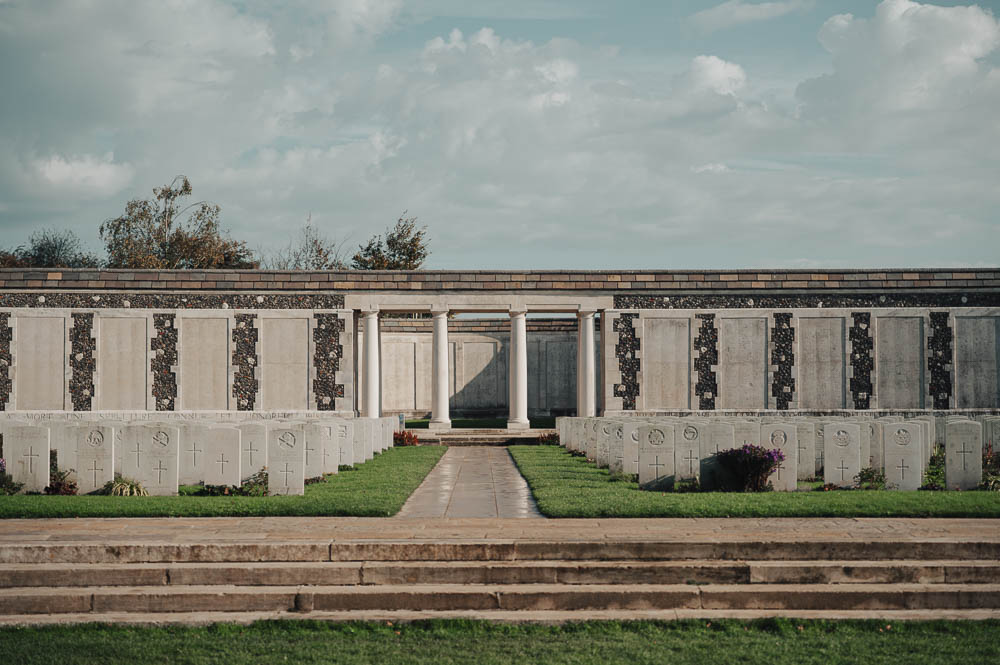
The current CWGC total is 34,936 names. The memorial is faced with Portland stone panels set into a long flint wall, with pavilions and sculptural figures. Unlike the Menin Gate, which is embedded in the city, Tyne Cot’s missing are commemorated while looking out over the battlefield where many of them disappeared.
The central section is especially important for New Zealand. Current CWGC material records 1,165 New Zealand names and 33,771 United Kingdom names on the memorial. New Zealand maintained its own system of memorials to the missing, which is why the national pattern of commemoration around Ypres differs from that of Australia or Canada.
Do not use the Menin Gate/Tyne Cot date split too simplistically
You will often read that the Menin Gate commemorates men who died before mid-August 1917 and Tyne Cot those who died later. That shorthand is useful, but it can become misleading if nationality and unit are ignored. The safest method for family research is always to use the individual CWGC record.
Tyne Cot’s memorial primarily covers United Kingdom and New Zealand missing associated with the later fighting in the Salient. Commonwealth commemoration policies were not identical for every Dominion. If you are tracing an Australian or Canadian soldier, do not assume the date automatically decides the memorial.
The father and son on Panel 108
Statistics become more understandable through individual stories. CWGC highlights Lieutenant Colonel Harry Moorhouse and his son Captain Ronald Moorhouse of the 4th Battalion, King’s Own Yorkshire Light Infantry.
On 9 October 1917, during the fighting associated with Poelcappelle, Ronald was badly wounded and brought to battalion headquarters. His father went to obtain medical help and was shot and killed by a sniper. Ronald also died. Neither has a known grave. Father and son are commemorated together on Panel 108 of the Tyne Cot Memorial.
The story condenses several realities of the Salient into one family: command responsibility, the vulnerability of even headquarters areas, the difficulty of casualty evacuation and the absence represented by a memorial name.
What the cemetery design is trying to do
Tyne Cot was designed by Sir Herbert Baker and John Truelove. Baker was one of the principal architects responsible for Commonwealth war cemeteries and memorials after the First World War. The site uses symmetry, long sight lines, flint walls, Portland stone and planting to bring order to ground created by violence.
Stand at the formal entrance and notice how the Cross of Sacrifice is aligned in the centre. Then move towards the wartime graves and the geometry loosens. The contrast is deliberate even if it developed from the practical history of burial. The architecture does not erase the battlefield; it organises it.
How to find a grave at Tyne Cot
Before visiting, search the CWGC database and write down the grave reference. A normal reference gives a plot, row and grave number. Cemetery plans are available at the entrance and through CWGC resources. Because Tyne Cot is so large, searching without a reference wastes time and can become frustrating.
If the casualty is commemorated on the memorial rather than buried in a known grave, note the panel number. The memorial register is kept in the northern shelter building. Again, confirm the unit because repeated surnames are common.
How long should you spend at Tyne Cot?
For a first general visit, allow around 45 to 60 minutes. That gives enough time to walk from the formal entrance towards the Cross, examine the blockhouses, reach the memorial and look back over the ridge. If you are finding a family grave or researching several names, allow longer.
Do not spend the entire visit in the central axis. Walk towards the edges. The scale becomes clearer when you look across the rows diagonally. The unidentified graves are easier to notice when you stop reading only famous names.
What should you see nearby?
Tyne Cot works best as part of the 1917 battlefield rather than as an isolated cemetery. Polygon Wood lies nearby and explains the successful Australian attacks of late September. Broodseinde is the immediate battle context for the ridge. The village of Passendale lies farther east and represents the objective eventually taken by Canadian troops in November.
The Memorial Museum Passchendaele 1917 in Zonnebeke gives a museum interpretation of the campaign. Crest Farm Canadian Memorial near Passendale adds the Canadian end of the story. The New Zealand Memorial at ’s Gravenstafel and Passchendaele New British Cemetery are important for visitors following New Zealand actions.
Tyne Cot and the meaning of Passchendaele
It is tempting to use Tyne Cot simply as a symbol of the mud of Passchendaele. The real story is richer. The site marks a German defensive ridge captured in a successful Allied attack. It contains wartime burials created around an aid post. It expanded through post-war battlefield clearance. It includes the remains of men from different years and battles. Its memorial records missing men from later phases of the Salient.
In one place you can therefore explain tactics, terrain, medical evacuation, post-war recovery, cemetery design and national remembrance. That is why Tyne Cot deserves more than a quick photograph from the central path.
Frequently asked questions
How many graves are at Tyne Cot Cemetery?
Current CWGC visitor material records 11,968 graves at Tyne Cot Cemetery.
How many names are on the Tyne Cot Memorial?
Current CWGC visitor material records 34,936 names on the Tyne Cot Memorial.
Why are so many graves unidentified at Tyne Cot?
The cemetery was greatly enlarged by post-war battlefield clearance. Years of shelling, damaged burial plots and lost identification made many recovered remains impossible to identify. CWGC notes that roughly seven out of ten graves are unidentified.
What are the concrete bunkers inside Tyne Cot?
They are surviving German blockhouses from the 1917 battlefield. One captured blockhouse became an aid post and the Cross of Sacrifice was later placed over the largest structure.
How long should I allow for Tyne Cot?
Allow at least 45 to 60 minutes for a general visit. Give more time if you are finding a family grave, memorial panel or studying the battlefield landscape in detail.
Historical details on this page were reviewed against current Commonwealth War Graves Commission material and other relevant official or national collections. Visitor information can change, so check the linked site or memorial authority if you are planning around a special ceremony or closure.

Private Ypres Battlefield Tour
Tyne Cot makes most sense when you first understand the ridge, the Australian capture of the German positions and the later Passchendaele fighting. A private day connects the cemetery to Polygon Wood, Broodseinde and Passendale.
Private tour for your own group. Current seasonal price and availability are shown on the booking page.
Check AvailabilityWritten and reviewed by Niels Declercq, private WW1 battlefield guide based in Bruges.