
Beaumont-Hamel Newfoundland Memorial: Complete Battlefield and Visitor Guide
↓ Jump straight to planning a private Somme battlefield tour
Beaumont-Hamel Newfoundland Memorial is one of the most important preserved First World War battlefield landscapes on the Western Front. Here the trenches, shell-cratered ground and slope across which the Newfoundland Regiment attacked on 1 July 1916 remain visible inside a memorial park maintained by Veterans Affairs Canada. At 9:15 a.m. that morning, 801 Newfoundlanders went into action. Only 68 answered the roll call of the unwounded the next day.
The site matters far beyond the casualty figures. Newfoundland was a separate dominion during the First World War and did not join Canada until 1949. Beaumont-Hamel therefore became part of Newfoundland's own national memory. July 1 is still observed in Newfoundland and Labrador as Memorial Day as well as Canada Day. The preserved battlefield allows visitors to understand why the attack was so difficult: the position of the trenches, the exposed slope, the German high ground and the short distance over which the regiment was destroyed.
- Date of Newfoundland attack: 1 July 1916 at 9:15 a.m.
- Regimental strength entering action: 801
- Unwounded at next roll call: 68
- Veterans Affairs Canada final figures: 233 killed or dead of wounds, 386 wounded and 91 missing
- Memorial opened: 7 June 1925 by Earl Haig
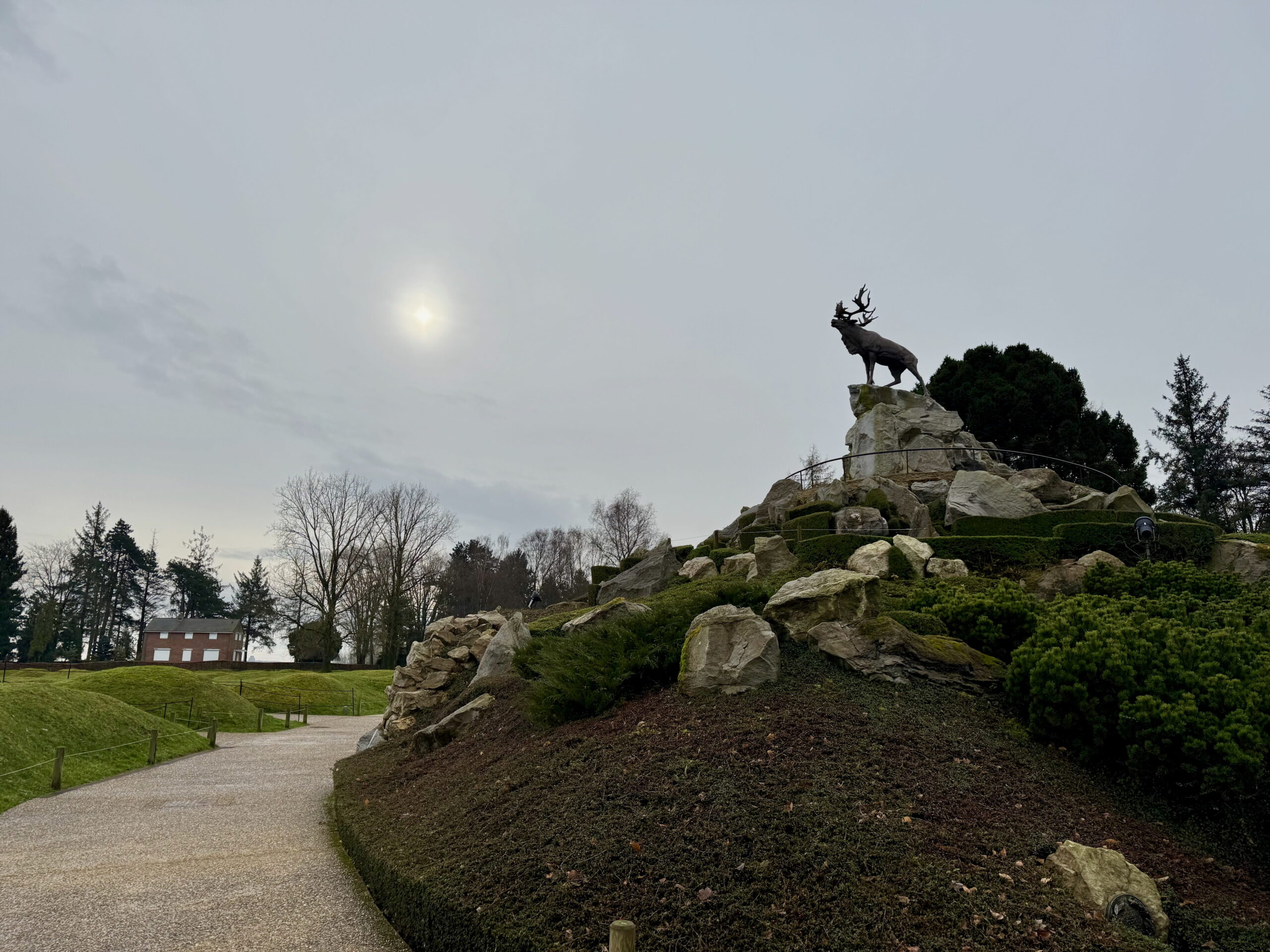
- Central symbol: Bronze caribou, emblem of the Royal Newfoundland Regiment
- Why the site is exceptional: Original trench lines and battlefield topography remain visible inside the memorial park
Newfoundland in 1914 was not part of Canada
This is the first fact every visitor should know. Newfoundland was a self-governing dominion of the British Empire in 1914. It had its own government and raised its own regiment for overseas service. Newfoundland and Labrador did not become a Canadian province until 1949.
Calling the men at Beaumont-Hamel simply “Canadian soldiers” therefore erases an important part of their identity. The site is administered today by Veterans Affairs Canada, but the soldiers who attacked on 1 July 1916 served Newfoundland.
Raising the Newfoundland Regiment
Newfoundland had a small population, so raising and sustaining an infantry regiment required a major national effort. Volunteers came from St John's and outport communities across the island and Labrador.
The first contingent became known as the Blue Puttees because khaki material was initially scarce and their lower-leg puttees were made from blue cloth. The nickname survived long after standard uniform equipment arrived.
Before the Somme
The regiment did not arrive in France as an untested unit. It served at Gallipoli in 1915, enduring difficult conditions and disease before the evacuation. Afterward it moved through Egypt and then to the Western Front.
By summer 1916 the Newfoundland Regiment formed part of the 88th Brigade of the 29th Division. The division included experienced units and had also fought at Gallipoli.
The Beaumont-Hamel position
The village of Beaumont-Hamel lay behind strong German positions north of the River Ancre. German trenches occupied higher ground and were protected by deep dugouts and wire.
The British front line lay below. Between the two systems stretched exposed no-man's-land broken by trenches, wire, shell holes and natural folds in the ground.
The preserved park makes this geography unusually clear. A modern visitor can physically trace the relationship between the British position and the German objective.
The Hawthorn Ridge mine
At 7:20 a.m., ten minutes before the main infantry assault, a huge British mine exploded under Hawthorn Ridge Redoubt nearby. The explosion was filmed by Geoffrey Malins and became one of the iconic images of the first day.
The early detonation has long been debated because it gave German defenders warning that an attack was imminent. British troops captured the crater lip but were unable to exploit it decisively.
The first attacks fail
The main British assault began at 7:30. In the Beaumont-Hamel sector, units of the 29th Division faced intact German fire. Machine guns swept approaches and wire slowed movement.
The attack quickly broke down. Communications were poor, and commanders behind the front did not have a clear real-time picture of what had happened.
Why the Newfoundlanders were ordered forward
The Newfoundland Regiment was held in reserve. By 9 a.m., reports reaching brigade command suggested some British troops might have reached German positions. The regiment was ordered to advance in support.
The information was tragically inaccurate. The initial assault had largely failed in the sector. Instead of moving through a captured gap, the Newfoundlanders would cross ground already covered by German machine guns.
9:15 a.m.: leaving St John's Road
The regiment moved from the support trench known as St John's Road. Congestion and shelling made it impractical to use the communication trenches toward the front line, so many men climbed out and advanced over open ground before even reaching the original British front.
This increased their exposure dramatically. They were visible to German defenders for much of the approach.
The Danger Tree
A dead tree stood near a point where the advancing Newfoundlanders tended to bunch as they tried to move through gaps in the wire. German machine-gun fire swept the area.
The tree became known as the Danger Tree. The original did not survive, but a preserved replacement stands on the approximate site. It should be described as a commemorative marker, not as the untouched trunk from 1916.
How long did the attack last?
The destruction happened rapidly. Veterans Affairs Canada describes the assault as effectively over within about thirty minutes. Men were hit before reaching the British front line, in the wire, and across no-man's-land.
Every officer who went forward in the Newfoundland attack was killed or wounded.
The casualty figures
Veterans Affairs Canada records that the regiment entered action 801 strong. The final figures gave 233 killed or dead of wounds, 386 wounded and 91 missing. Only 68 men answered the roll call of the unwounded the next morning.
These official figures are preferable to older simplified totals that sometimes appear online. They also show why “710 casualties” and “68 unwounded” are different ways of expressing the same catastrophe.
Why the loss affected Newfoundland so deeply
Newfoundland's population was small. The regiment drew volunteers from communities in which families knew one another closely. News of the losses therefore spread through an entire society rather than disappearing into the statistics of a huge country.
The battle became a national trauma. The date of 1 July developed a meaning in Newfoundland distinct from the later Canadian celebration of Confederation.
Newfoundland's Western Front
Follow the Newfoundland Regiment beyond Beaumont-Hamel
Beaumont-Hamel is the heart of the story, but the regiment's Western Front history continues across the network of Caribou memorials in France and Belgium.
Explore the Caribou Trail
Private Newfoundland-focused Western Front tour
Memorial Day on 1 July
Newfoundlanders commemorated 1 July as Memorial Day after the First World War. When Newfoundland joined Canada in 1949, the same date was already celebrated nationally as Dominion Day, later Canada Day.
Today both meanings coexist. In Newfoundland and Labrador, the morning can be marked by remembrance of the fallen before Canada Day celebrations later in the day.
The caribou memorial
The bronze caribou is the emblematic feature of the park. It stands on a rocky mound overlooking the battlefield and faces toward the former German lines.
The caribou was chosen as the symbol of the Newfoundland Regiment. Similar caribou memorials were placed on important battlefields across Europe, creating the Newfoundland Trail of the Caribou.
The names at the memorial
Bronze tablets at the base of the memorial carry the names of more than 800 Newfoundlanders from the regiment, the Newfoundland Royal Naval Reserve and Mercantile Marine who died during the war and have no known grave.
This means the caribou memorial is not only about the 1 July attack. It is also a memorial to missing Newfoundlanders from across the wider war.
The preserved trench system
Beaumont-Hamel is exceptional because the ground was acquired for memorial purposes rather than simply returned to intensive agriculture. Original trench lines remain visible as grassed depressions.
They have naturally eroded and been maintained over more than a century, so visitors should not imagine every bank has exactly the same 1916 profile. What survives is the authentic trench alignment and battlefield topography.
Why the trenches look shallow
Many preserved trenches now look much shallower than wartime photographs. Earth slumps, vegetation grows and frost gradually softens edges.
In 1916 trenches could be deep enough for men to move with some protection below the parapet. Modern grassed contours show location rather than exact original depth.
The German lines
The park also preserves sections of German positions. Walking toward them makes the battlefield three-dimensional. The German defenders were not simply “across a field”; they occupied organized trenches on commanding ground.
Look back toward the caribou from the German side. The exposed British and Newfoundland approach becomes immediately obvious.
The Y Ravine
Y Ravine was a natural feature incorporated into the German defensive system. Deep dugouts and shelters used the ground effectively.
The ravine helped protect defenders from the British bombardment and provided depth behind the front trench. It is one of the reasons artillery alone could not simply erase the position.
51st Highland Division Memorial
Beaumont-Hamel was finally captured in November 1916 during the Battle of the Ancre. The 51st (Highland) Division played the central role in taking the position.
The division's memorial stands within the park, creating a second important story: the ground that resisted on 1 July was eventually captured months later after tactics and conditions had changed.
Hunter's Cemetery
Hunter's Cemetery is a small circular Commonwealth cemetery inside the park. It occupies a shell crater used for burials after the November fighting.
Its shape gives an unusually direct connection between battlefield destruction and later burial. The crater that scarred the ground became a cemetery.
Y Ravine Cemetery
Y Ravine Cemetery lies at the edge of the preserved battlefield and contains Commonwealth graves from the Somme fighting. Its location helps connect the preserved terrain with the wider burial landscape.
Many men killed on the Somme have no known grave, but the cemeteries show how bodies recovered from the area were gathered and commemorated.
The Sunken Lane
Just outside the memorial park lies the Sunken Lane associated with Geoffrey Malins' film of the Lancashire Fusiliers before the 1 July attack. The lane survives as a physical landscape feature.
Combining it with Beaumont-Hamel creates an exceptional interpretive sequence: wartime film, preserved terrain and modern memorialization within walking or very short driving distance.
What happened here in November 1916?
On 13 November British forces attacked during the Battle of the Ancre. The 51st Highland Division assaulted Beaumont-Hamel with improved artillery support and a more sophisticated plan than the July operation.
The village and surrounding positions were captured. The contrast between July and November provides one of the clearest examples of tactical learning during the Somme campaign.
The battlefield was not preserved by accident
After the war Newfoundland acquired several battlefield sites in France and Belgium. Beaumont-Hamel became the largest and most elaborate of these parks.
Landscape architect Rudolph Cochius helped create the memorial park. Trees, paths and planting were introduced deliberately around surviving battlefield features. The site is therefore both preserved battlefield and designed remembrance landscape.
Opening in 1925
The park was officially opened by Field Marshal Earl Haig on 7 June 1925. Veterans and families attended. For Newfoundland, the site became a national place of pilgrimage thousands of kilometres from home.
The memorial park's existence before Newfoundland joined Canada is another reminder of its distinct national origin.
Student guides
Veterans Affairs Canada operates a guide programme at Beaumont-Hamel during the main visitor season. Canadian student guides provide interpretation of the park and Newfoundland story.
Availability and operating periods can change, so visitors should check current Veterans Affairs Canada information rather than relying on old blog opening hours.
How long to allow
Forty-five minutes is the minimum for a self-guided walk focused on the caribou and trenches. Ninety minutes is much better if you want the German lines, cemeteries, Highland memorial and the wider tactical story.
With a guided visit, allow enough time to stop on the ground rather than treating the park as a quick memorial photograph.
What to notice while walking
Measure distance with your eyes. Note how far the Newfoundlanders had to move before reaching the British front line. Look at the slope toward the German positions. Find the Y Ravine and identify how natural ground strengthened the defence.
The site explains the attack through geography better than any casualty table can.
Family-history research
If you are tracing a Newfoundland serviceman, bring his service number, company if known, date of casualty and memorial or grave reference. Newfoundland records, battalion histories and war diaries can often narrow his likely route across the park.
A name on the caribou or a cemetery headstone becomes much more meaningful when connected with the exact company position.
Why Beaumont-Hamel remains essential
Many Western Front sites require imagination because agriculture erased the trenches. Beaumont-Hamel does not. Visitors can still see the shape of the battlefield.
That makes it one of the strongest places for teaching how terrain, mistaken information, communications and surviving machine guns combined to turn an order to advance into disaster.
Guide's perspective: do not walk straight to the caribou. Start in St John's Road. Follow the Newfoundlanders' direction of advance. Stop before the Danger Tree and look toward the German line. Only then climb to the memorial and look back. The landscape tells the story in the right order.
Frequently asked questions
How many Newfoundlanders attacked at Beaumont-Hamel?
Veterans Affairs Canada records 801 men of the Newfoundland Regiment going into action on 1 July 1916.
How many answered roll call the next day?
Only 68 answered the roll call of the unwounded the following morning.
Was Newfoundland part of Canada in 1916?
No. Newfoundland was a separate dominion of the British Empire and joined Canada only in 1949.
Are the trenches at Beaumont-Hamel original?
The trench alignments and battlefield topography are genuine and preserved. Natural erosion and conservation mean the present grassed profiles are not identical in depth and sharpness to 1916.
Is the Danger Tree original?
No. The present preserved tree marks the traditional location associated with the original tree where men were exposed during the attack.
How long should I spend at Beaumont-Hamel?
Allow at least 45 minutes for a basic self-guided visit and around 90 minutes for a fuller battlefield walk and interpretation.

Private Somme & Northern France Battlefield Tour
Walk the preserved battlefield with the Newfoundland story in its full Somme context, then connect Beaumont-Hamel with the Sunken Lane, Thiepval and other Caribou Trail sites.
Private full-day tour for your group. Current seasonal price and availability are shown on the tour page.
Check AvailabilityWritten by Niels Declercq, private WW1 battlefield guide based in Bruges.