
Pozières 1916: The Australian Battle, Windmill Site and 23,000 Casualties
↓ Jump straight to planning a private Somme battlefield tour
Pozières is one of the most important Australian battlefields on the Western Front. Between 23 July and early September 1916, the Australian 1st, 2nd and 4th Divisions fought for the village, the ridge, the Old German trench lines and the approaches to Mouquet Farm. They suffered about 23,000 casualties in roughly six weeks, including around 6,800 men killed or dead of wounds. The Australian War Memorial describes the losses as almost unsustainable for a volunteer army.
The modern village is rebuilt and the ridge looks peaceful, so Pozières needs explanation. Its importance came from elevation. The high ground offered observation over a wide section of the Somme battlefield. German artillery therefore fought intensely to deny it to the Australians. The village was captured, but the troops holding it endured bombardments so severe that official historian Charles Bean later described the ridge as being more densely sown with Australian sacrifice than any other place on earth.
- Main Australian period: 23 July to early September 1916
- Australian divisions: 1st, 2nd and 4th Divisions
- Australian casualties: About 23,000
- Australian dead or dead of wounds: About 6,800
- Key objectives: Pozières village, Pozières Heights, Old German trench lines, Windmill site and approaches to Mouquet Farm
- Why the ridge mattered: Observation over the surrounding Somme battlefield
- Main visitor sites: 1st Australian Division Memorial, Windmill Site, Tank Corps Memorial and Pozières Memorial/Cemetery
Why Australians arrived on the Somme
After Gallipoli, the Australian Imperial Force was reorganized and expanded in Egypt before moving to France. Australian divisions first entered the quieter Armentières sector to gain Western Front experience.
In July 1916 the Somme offensive created an urgent need for fresh formations. The disastrous Australian attack at Fromelles on 19–20 July involved the 5th Division. Only days later the 1st Australian Division entered the battle at Pozières.
The village on the Albert-Bapaume road
Pozières sat directly on the main road from Albert toward Bapaume. More importantly, it occupied part of the high ground that dominated the battlefield.
Whoever controlled the ridge could improve artillery observation. That made the village and nearby windmill position tactically valuable far beyond their small size.
Why the British had not taken Pozières on 1 July
The opening-day attack failed to secure the northern high ground around Thiepval and Pozières. German positions remained intact enough to prevent a breakthrough.
As British forces advanced elsewhere during July, capturing Pozières became increasingly important for attacking the ridge and eventually threatening Thiepval from another direction.
23 July: the 1st Australian Division attacks
The Australian assault began shortly after midnight on 23 July. Attacking at night reduced some observation problems and allowed troops to approach under artillery support.
The 1st Division captured much of the village and established positions beyond it. The tactical success immediately created another problem: the Germans could now shell the captured area from surrounding positions.
A village disappears under artillery
German artillery bombarded Pozières relentlessly. Buildings that had survived earlier fighting were smashed into rubble. Trenches collapsed and routes became difficult to identify.
For soldiers, the danger was not only during attacks. Holding the captured village under bombardment caused a huge proportion of the casualties.
What shell shock meant here
Pozières became one of the Australian Imperial Force's most extreme artillery experiences. Men endured hours and days of explosions, concussion, burial by earth and lack of sleep.
Contemporary soldiers described men trembling, crying or becoming unable to function. Wartime medicine used terms such as shell shock, but modern readers should avoid diagnosing individuals casually. The evidence clearly shows severe psychological trauma regardless of terminology.
The 1st Division's losses
The 1st Australian Division suffered more than 5,000 casualties during its first tour around Pozières. It had captured the village but paid heavily to hold it.
The division's memorial now stands near the village and lists its major Western Front battles.
The 2nd Division and the heights
The 2nd Australian Division relieved the 1st and was ordered to capture the ridge east of the village, including the Old German trench system.
An attack on 29 July failed at severe cost. The division's commander, Major-General Gordon Legge, requested the opportunity to attack again rather than leave the objective after failure.
4 August: the ridge is taken
After further preparation, Australian troops attacked again and secured the Pozières Heights and important sections of the Old German lines.
The success placed the Australians on the key high ground, but it increased German determination to bombard and counter-attack the position.
The Old German lines
Often abbreviated as O.G.1 and O.G.2 in Australian accounts, these trench lines formed important German positions east of Pozières.
They were not simply two tidy ditches. The system included communication trenches, strongpoints and dugouts. Capturing them required repeated local attacks and consolidation.
The Windmill
A windmill had stood on the ridge before the war. By 1916 it was destroyed, but the site remained a useful geographic reference and strongpoint.
The Germans fortified the area. Once Australians reached the ridge, the Windmill Site became one of the strongest symbols of their sacrifice at Pozières.
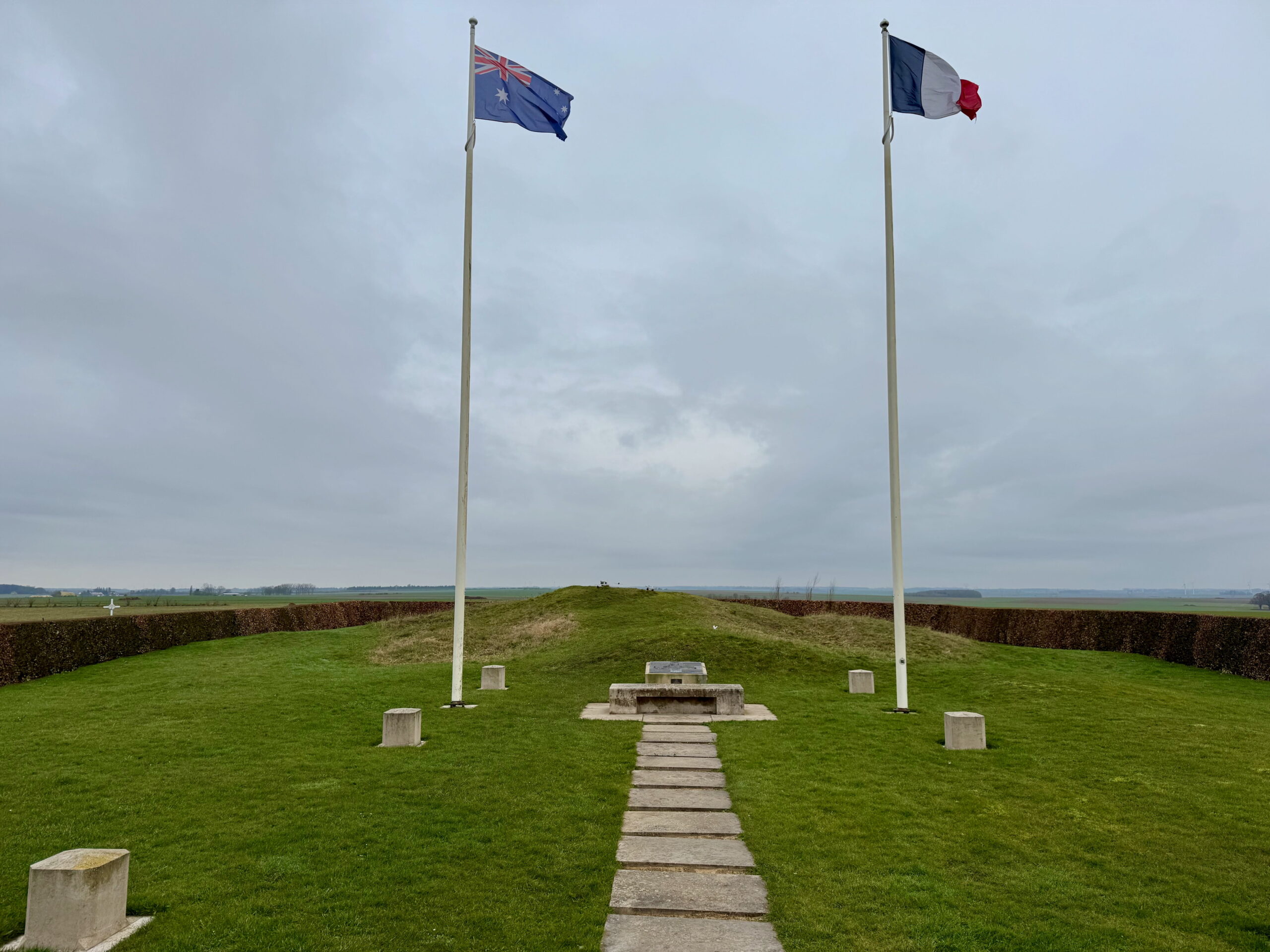
The Windmill Site today
The Australian government acquired the ground after the war. The old mound remains as a memorial landscape rather than a reconstructed windmill.
The site carries a stone bench with words based on Charles Bean's famous description of the ridge as being more densely sown with Australian sacrifice than any other place on earth.
Why Bean's sentence matters
Bean was Australia's official war correspondent and later official historian. He witnessed the Somme fighting and saw its effect on the Australian divisions.
His description became central to Australian memory because it links one physical mile of French ground with national loss. It is especially powerful when standing on the ridge rather than reading it in a museum.
23,000 Australian casualties
The Australian War Memorial records about 23,000 casualties during the Pozières and Mouquet Farm fighting over roughly six weeks. About 6,800 were killed or died of wounds.
The total was comparable to Australia's losses over the much longer Gallipoli campaign. This explains why historians sometimes ask why Pozières is less well known to the Australian public.
Australian Western Front Tour
Follow the Australian story beyond Pozières
Connect Pozières and Mouquet Farm with the wider Australian story of the Somme and the Western Front on a private battlefield day.
Follow the Australian Trail
Private full-day Australian battlefield tour
Why Gallipoli remains more famous
Gallipoli had a clear national narrative: landing, months of fighting and evacuation in a distinct campaign. It became closely connected with Anzac Day.
Pozières was one phase inside the vast Somme campaign. The battlefield name therefore competes with “Somme” in public memory even though the Australian losses were enormous.
The 4th Australian Division
The 4th Division relieved exhausted troops on the ridge and continued attacking north-west toward Mouquet Farm. German bombardment remained intense.
The division's experience demonstrates that Pozières was not simply about capturing one village. The Australians were being used to extend the British advance across a broader ridge system.
Mouquet Farm
Mouquet Farm, known to Australians as “Moo-Cow Farm”, lay north-west of Pozières. German troops had created dugouts and defensive positions around the farm ruins.
Australian attacks repeatedly approached and entered parts of the position without securing it permanently. The struggle added thousands more casualties to the Pozières total.
Why Mouquet Farm was so difficult
The farm sat near strong German positions and could be supported from the direction of Thiepval. Underground shelters allowed defenders to survive artillery and reappear behind attackers.
Operations around the farm also became difficult because Australian divisions were worn down after repeated tours.
The Tank Corps Memorial
A memorial near Pozières commemorates the first tank operations of 1916. Tanks did not play a major role in the July capture of the village; their battlefield debut came later at Flers-Courcelette in September.
The memorial's location on the ridge reflects the wider Somme battlefield rather than one Australian attack.
The 1st Australian Division Memorial
The memorial stands at Pozières because the division's first major Western Front victory occurred here. It is one of several divisional memorials placed on battlefields important to Australian formations.
The simple stone obelisk carries the names of battles rather than individual soldiers. It commemorates the division as a formation.
Pozières British Cemetery and Memorial
Nearby Pozières British Cemetery contains Commonwealth graves, while the Pozières Memorial commemorates missing soldiers from later operations in the region.
It is important not to confuse the cemetery and memorial with a specifically Australian national cemetery. The burial landscape is Commonwealth and reflects multiple periods of fighting.
Charles Bean and the idea of an Australian war memorial
Bean's experience on the Western Front contributed to his determination that Australia should preserve records, relics and stories of its soldiers. He collected material during the war that later became part of the Australian War Memorial's national collection.
Pozières therefore connects not only with battlefield history but with the creation of Australia's central institution of military remembrance.
The Victoria Crosses of Pozières
Five Australian soldiers received the Victoria Cross for actions associated with the Pozières fighting: John Leak, Arthur Blackburn, Thomas Cooke, Claud Castleton and Martin O'Meara.
Their stories show different kinds of courage: attacking strongpoints, carrying messages, rescuing wounded men and continuing under intense fire.
Thomas Cooke and the Lewis gun
Private Thomas Cooke fought with a Lewis gun during the attack and was killed while continuing to fire under heavy pressure. He received the Victoria Cross posthumously.
His body was not identified, making him one of the thousands for whom the Somme battlefield itself became the grave.
Martin O'Meara
Private Martin O'Meara repeatedly went into exposed ground to rescue wounded men and bring them to safety. He survived the war but later suffered severe mental illness.
His story is useful because heroism did not protect soldiers from the long-term psychological consequences of combat.
Pozières as an artillery battle
Infantry attacks are easier to narrate because they have start times and objectives. The defining experience at Pozières was often simply enduring shellfire.
German gunners knew the narrow ridge and road network through which Australian troops and supplies had to pass. Concentrated bombardment could devastate those routes.
Why shells caused so many missing men
Repeated heavy bombardment could bury bodies, destroy temporary graves and scatter remains. Ground captured and recaptured might be shelled again before burial parties reached it.
This helps explain why many Australian soldiers killed at Pozières have no known grave and are commemorated on the Villers-Bretonneux Memorial rather than buried under identified headstones nearby.
Pozières and the Australian National Memorial
Australia's main national memorial to its missing in France stands at Villers-Bretonneux, not Pozières. This often surprises visitors given the scale of Australian loss on this ridge.
The commemorative system separates battlefield location from the later choice of national memorial site.
How the modern village hides the battle
Pozières was rebuilt after the war. Houses, roads and farmland now cover much of the devastated landscape.
The village itself can therefore seem visually disappointing until the visitor understands the ridge. The Windmill Site and road alignment make the tactical position much clearer.
Stand at the Windmill and look outward
The best interpretation is geographic. Identify Albert behind you, Bapaume ahead, Thiepval and Mouquet Farm to the west and Courcelette farther north.
The ridge becomes a platform controlling several directions. That is why the Germans fought so hard to hold it and why Australian troops were ordered to keep attacking.
Pozières and Courcelette
Canadian troops later fought around Courcelette in September. The village lies farther along the same general ridge system.
Combining Pozières and Courcelette demonstrates how different Dominion forces entered the Somme at different times and objectives.
How long to spend
Allow 45 minutes for the Windmill Site, divisional memorial and battlefield orientation. An Australian-focused visit with Mouquet Farm, cemetery research and individual soldiers can easily take two hours or more.
The site combines naturally with Thiepval because the Australian attacks toward Mouquet Farm were connected with the wider struggle for the Thiepval positions.
Family-history research at Pozières
Australian service dossiers and unit war diaries are unusually rich resources. Start with the soldier's battalion and exact date, then identify which division was in the line.
The difference between 23 July, early August and late August can place a man in very different parts of the battlefield. “He fought at Pozières” is only the beginning of the research.
Why Pozières matters
Pozières shows how national memory can overlook a battlefield despite enormous loss. It also shows the difference between capturing ground and surviving on it.
The Australians took the village and ridge. The German artillery then made possession almost unbearable. Victory and suffering existed at the same time.
Guide's perspective: start at the Windmill Site and do not point first toward the village. Point along the ridge. Explain observation. Then show the casualty figure. The Australians were not dying for a cluster of ruined houses; they were fighting for the high ground beneath your feet.
Frequently asked questions
When did Australians fight at Pozières?
The main Australian fighting began on 23 July 1916 and continued through August into early September as the 1st, 2nd and 4th Divisions fought for the village, ridge and Mouquet Farm.
How many Australian casualties were there?
The Australian War Memorial records about 23,000 casualties during the Pozières fighting, including around 6,800 killed or dead of wounds.
Why was Pozières important?
The village and Windmill Site sit on high ground that offered valuable artillery observation across the Somme battlefield.
What is the Pozières Windmill Site?
It is the preserved mound and ridge where the destroyed windmill once stood. The Australian government acquired the site after the war as a memorial to the fighting and sacrifice on the ridge.
Which Australian divisions fought there?
The 1st, 2nd and 4th Australian Divisions all fought repeated tours around Pozières and Mouquet Farm.
How long should I spend at Pozières?
Allow at least 45 minutes for the main memorial sites and terrain. A detailed Australian or family-history visit can take two hours or more.

Private Somme & Northern France Battlefield Tour
Follow the Australian divisions from Pozières village and the Windmill Site toward Mouquet Farm, then connect the ridge with Thiepval, Lochnagar and the wider Somme campaign.
Private full-day tour for your group. Current seasonal price and availability are shown on the tour page.
Check AvailabilityWritten by Niels Declercq, private WW1 battlefield guide based in Bruges.