
Vimy Ridge: The Canadian Corps, the 1917 Battle and National Memorial
↓ Jump straight to planning your private battlefield tour
Vimy Ridge is one of the most important Canadian First World War battlefields in France and one of the clearest places to understand how terrain, artillery and preparation shaped fighting on the Western Front. From 9 to 12 April 1917, all four divisions of the Canadian Corps attacked the German-held ridge as part of the wider Battle of Arras. Most of the ridge was captured on the first day and the remaining resistance was overcome by 12 April. Canadian losses were 10,602 casualties, including 3,598 killed.
The battlefield had already cost France heavily before the Canadians arrived. French armies fought major battles in Artois in 1915 while trying to seize the same dominating heights. The modern Canadian National Vimy Memorial stands on Hill 145, the highest point of the ridge and one of the Canadian Corps' principal objectives. Its walls carry the names of 11,285 Canadian soldiers who died in France and have no known grave. Those names are not simply the dead of the Vimy battle. The monument is Canada's national First World War memorial in Europe.
- Battle: 9–12 April 1917
- Canadian casualties: 10,602, including 3,598 killed
- Names on memorial: 11,285 Canadians who died in France with no known grave
- Highest point: Hill 145
- Memorial architect: Walter Seymour Allward
- Recommended time: Up to two hours for monument, cemeteries and visitor centre
Why Vimy Ridge mattered
The ridge rises above the Douai Plain and gave the German army valuable observation over roads, railways, villages and artillery positions to the east. In the relatively open landscape of Artois, a modest difference in elevation could shape an entire sector because observation allowed artillery to be directed with far greater accuracy.
German forces had held and strengthened the ridge since 1914. Their system included front trenches, support positions, deep dugouts, machine-gun posts and communication routes. The Canadian Corps was therefore attacking a defended landscape, not simply a line on a map.
The French battles before Vimy
Vimy did not begin as a Canadian battlefield. French armies attacked repeatedly in Artois during 1915 and suffered severe casualties while attempting to capture the ridge and neighbouring high ground. Notre-Dame-de-Lorette and the surrounding French cemeteries preserve that earlier story.
This context is essential because the Canadian operation inherited two years of accumulated knowledge about German positions, artillery problems and the difficulty of moving across the chalk ridge.
The Canadian Corps in 1917
By spring 1917 the Canadian Corps had already fought at Second Ypres, Mount Sorrel and on the Somme. It was no longer an inexperienced formation. At Vimy, all four Canadian divisions would attack within one corps operation for the first time.
The corps formed part of the British First Army. Vimy was therefore a Canadian achievement inside the much larger Battle of Arras, not an isolated national war fought separately from British and Allied strategy.
Rehearsals, maps and preparation
Preparation became one of the defining features of the operation. Troops studied models and maps. Objectives were divided into stages. Junior leaders were briefed on plans beyond their immediate task so that units could continue if officers became casualties.
These methods did not remove uncertainty. They reduced it. On a battlefield where communications could fail within minutes, knowing the intended route and neighbouring objectives gave small groups a better chance of maintaining direction.
The artillery problem
Artillery was central to the plan. Heavy guns targeted trenches, strongpoints and German batteries. Counter-battery work attempted to identify and suppress enemy artillery before it could break up the attack.
A creeping barrage moved forward ahead of the infantry. The timing had to be precise. If attackers fell too far behind, defenders had time to emerge from shelters and man machine guns. If men moved too close, they risked being hit by their own shells.
The underground war
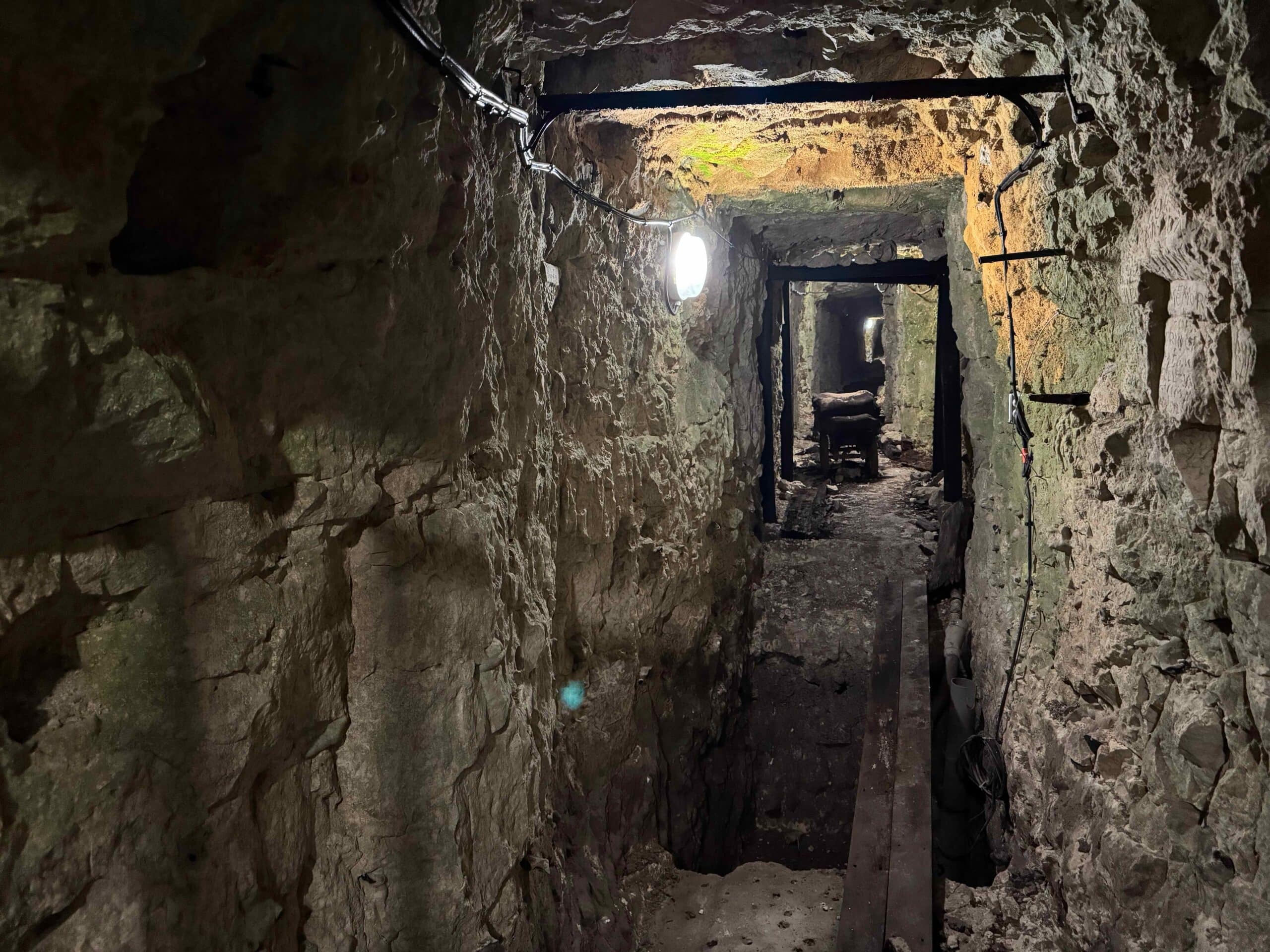
Five British tunnelling companies excavated fourteen subways in the Canadian Corps sector. Veterans Affairs Canada notes that the longest extended more than 1,700 metres. These passages helped troops, signals and supplies move under some protection before the attack.
Mining and tunnelling were therefore integrated into the assault system. Vimy is one of the strongest places to explain that the Western Front was fought below ground as well as on the surface.
9 April 1917
The assault began on Easter Monday in cold weather, with snow and sleet crossing the battlefield. Canadian infantry advanced toward successive objectives behind the barrage while engineers and support troops followed to open routes and consolidate captured positions.
Most of the ridge was taken on the first day. Hill 145 remained difficult, and the northern end of the system required further fighting, but the central result was clear: the Canadian Corps had broken into and captured the commanding ridge.
Hill 145
Hill 145 is the highest point on Vimy Ridge and today carries the national memorial. Capturing it mattered because it dominated the surrounding ground and anchored the German position.
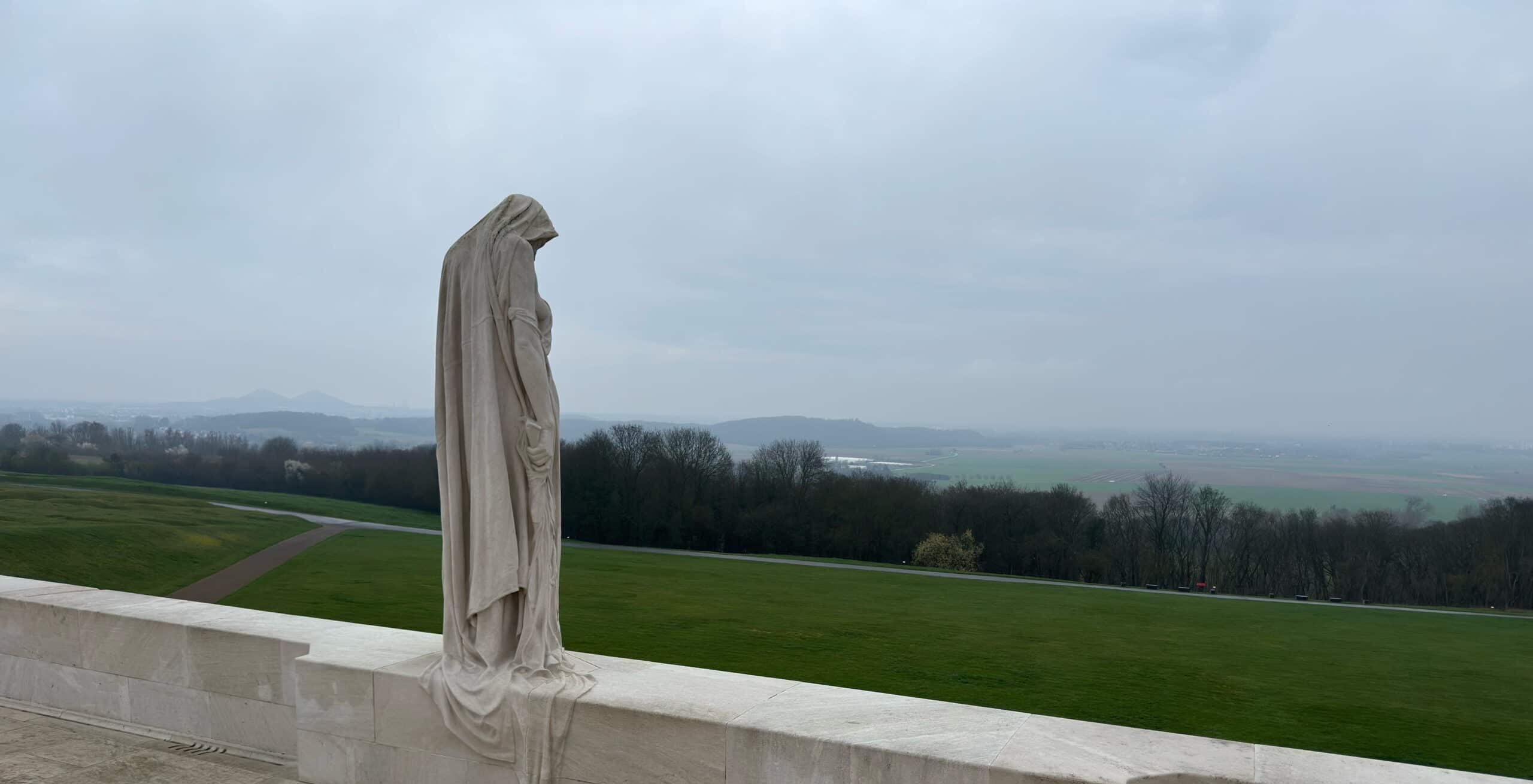
Standing beneath the memorial, visitors can easily forget that the monument was placed here because this was an objective first. The view over the plain explains the military logic before the architecture explains the remembrance.
The Pimple and 12 April
The northern end of the ridge contained another strong feature known as the Pimple. Canadian operations continued after 9 April, and the final German resistance on the ridge was overcome by 12 April.
This is why the battle should not be compressed into one morning even though 9 April remains the principal commemorative date.
10,602 Canadian casualties
Canadian casualties totalled 10,602, including 3,598 killed. The figures demonstrate an important Western Front truth: good planning could produce tactical success without producing low casualties.
The number of missing men inscribed on the memorial is a completely different figure. The 11,285 names represent Canadians who died in France and had no identified grave, not the number who died at Vimy.
Sir Julian Byng and Arthur Currie
Lieutenant-General Sir Julian Byng commanded the Canadian Corps during the battle. Major-General Arthur Currie commanded the 1st Canadian Division and would take command of the corps later in 1917.
Currie's later reputation for meticulous planning is often projected backward onto Vimy. His role was important, but the success was built by a corps-wide system involving artillery specialists, engineers, staff officers and divisional commanders.
Was Vimy the birth of a nation?
The phrase is deeply embedded in Canadian public memory, but it is better treated as an interpretation than a literal historical fact. Canada already had political institutions, identity and national debates long before April 1917.
Vimy became powerful because all four Canadian divisions fought together, because the battle was successful and because the memorial later gave the event an extraordinary physical symbol. It became one of the places through which Canadians chose to interpret the country's wartime experience.
The national memorial
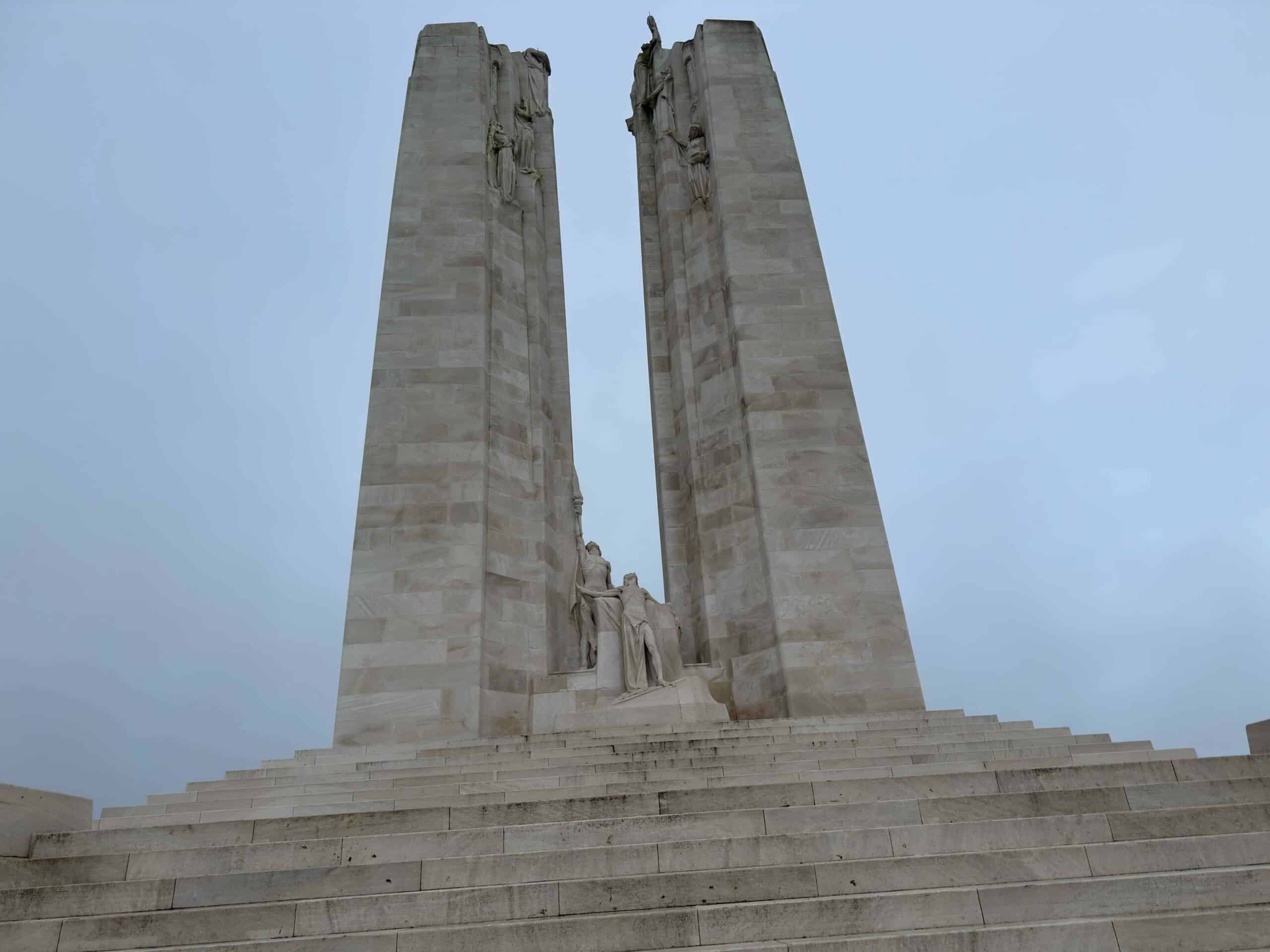
After the war France and Belgium granted Canada eight battlefield sites for commemoration. A national design competition was held. Walter Seymour Allward's proposal was so ambitious that it was chosen for one principal national monument rather than repeated at every Canadian site.
The two great pylons symbolize Canada and France. Sculpted figures express mourning, sacrifice, justice, peace and protection rather than depicting combat.
The 11,285 missing
Carved on the monument are the names of 11,285 Canadian soldiers who died in France and whose bodies were unidentified or unrecovered at the time of commemoration.
They come from many French battlefields, not simply Vimy. The monument is therefore local in location but national in commemorative purpose.
Canadian Western Front Tour
Make Vimy part of the wider Canadian story
Vimy Ridge is only one chapter. Follow Canada's Western Front story through Vimy, Hill 70, the Somme, Passchendaele and other sites connected to Canadian service.
Explore the Canadian Trail
Private full-day tour · Family-history research can be included
Preserved trenches
Veterans Affairs Canada explains that the trenches visible today were reconstructed during the memorial-building period in the same positions as Canadian and German outpost lines. At some points the opposing trenches are only about 25 metres apart.
That distinction makes the site more accurate, not less impressive. Visitors are walking through authentic positions on the battlefield, but the concrete and trench profiles have been stabilized and reconstructed for preservation.
Shell holes, craters and unexploded ammunition
Large areas of the memorial grounds remain cratered. Some are closed because unexploded ammunition remains a genuine hazard more than a century after the war.
Sheep grazing is used in sensitive areas partly because it avoids heavy mechanical mowing and ground disturbance. The apparently pastoral scene is therefore connected directly to battlefield safety.
Givenchy Road Canadian Cemetery
Givenchy Road Canadian Cemetery lies within the memorial park and contains 108 Canadians from the Battle of Vimy Ridge. Its small scale provides a useful contrast with the national monument.
Here the story moves from national memory to individual graves, ages, units and family inscriptions.
Canadian Cemetery No. 2
Canadian Cemetery No. 2 contains nearly 3,000 Commonwealth burials, including more than 450 Canadians. Many graves are unidentified.
Together the cemeteries and the memorial show three different commemorative outcomes: identified burial, unidentified burial and a named missing serviceman with no known grave.
The visitor centre
The modern visitor centre opened in 2017 and provides interpretation of Canada's First World War experience. Student guides are available during the operating season.
Access to tunnels, guided interpretation and opening hours can change. Visitors should check current Veterans Affairs Canada information when a tunnel tour or visitor-centre programme is important to the day.
How long to spend at Vimy
Veterans Affairs Canada advises allowing up to two hours for the monument, cemeteries and visitor centre. A serious battlefield visit can easily use that time without feeling slow.
If Vimy is only one stop among many, the route should still protect enough time to see the ridge and trenches. A twenty-minute photograph stop misses the reason the place matters.
Vimy and the wider Arras battlefield
Notre-Dame-de-Lorette, the Ring of Memory, Arras, Hill 70 and the Arras Flying Services Memorial extend the story beyond one national site. They also restore French, British and air-war perspectives to a region often visited only through Canadian memory.
A dedicated Canadian Northern France day can follow the corps from Courcelette and Vimy to Hill 70 and the Hundred Days, showing how its methods changed between 1916 and 1918.
Guide's perspective
Start with the view over the Douai Plain. Explain why the ridge mattered before mentioning national symbolism. Then walk the trench positions. Only after visitors understand the military ground should the group approach Allward's memorial. The architecture becomes stronger because the battlefield has already been read.
The German view from the ridge
The ridge was valuable to the Germans because it protected observation over the Douai Plain and the industrial area beyond. German defenders had spent years adapting the position to artillery warfare. Dugouts, trench systems and communication routes were designed to keep troops alive through bombardment and return them to firing positions when the barrage moved on.
That defensive logic is important when standing in the preserved area today. The German front was not simply a wall to be broken. It was a system intended to absorb attack, survive shellfire and use higher ground to make every British and Canadian movement costly.
What changed after the ridge was captured?
Taking Vimy improved Allied observation and removed a major German position, but it did not produce a decisive breakthrough into open country. The Battle of Arras continued elsewhere, and German forces established new defensive positions farther east.
This is another reason to resist turning Vimy into a simple story of one dramatic victory ending a problem. The ridge mattered operationally, but the Western Front remained a functioning defensive system after it fell.
Vimy in Canadian memory after 1918
The battle's place in Canadian memory grew after the war. Pilgrimages, veterans' organizations, school teaching and the construction of Allward's memorial all helped turn Vimy into a national symbol. The monument itself shaped memory because it gave Canadians one overwhelming physical place in Europe around which remembrance could gather.
This post-war process is historically important. Nations do not remember every battle equally. Vimy became central partly because of what happened in 1917 and partly because later generations chose to make it central.
Construction of the memorial
Building the monument took years. The site required preparation, stone selection, sculptural work and engineering on a battlefield still containing unexploded ammunition and disturbed ground. The memorial was finally unveiled in 1936 in the presence of King Edward VIII and large numbers of Canadian pilgrims and veterans.
That 1936 ceremony was itself a major event in Canadian remembrance. For many veterans it was the first return to the battlefield since the war.
Vimy during the Second World War
When France fell in 1940, concern spread in Canada that the memorial might have been damaged or destroyed. German authorities later allowed inspection and publicized that the monument remained intact.
The episode shows how quickly a First World War memorial had itself become a historical object worth protecting and worrying about during a second European war.
Why Vimy is useful for first-time battlefield visitors
The site combines several elements that are usually separated elsewhere: national memorial architecture, cemeteries, preserved battlefield ground, trenches, tunnels, cratered terrain and a commanding view.
That makes it one of the best places to teach the basic grammar of the Western Front in one visit. A visitor can move from military problem to human loss to national remembrance without leaving the ridge.
Frequently asked questions
When was the Battle of Vimy Ridge?
The Canadian attack began on 9 April 1917 and the final German positions on the ridge were overcome by 12 April.
How many Canadians were killed at Vimy Ridge?
3,598 Canadians were killed. Total Canadian casualties were 10,602.
How many names are on the Vimy Memorial?
The monument carries 11,285 names of Canadian soldiers who died in France and have no known grave.
Are the trenches original?
They preserve the authentic positions of the 1917 lines, but the visible trenches were reconstructed and stabilized during the memorial-building period.
How long should I visit?
Veterans Affairs Canada recommends allowing up to two hours if visiting the monument, cemeteries and visitor centre.
Is Vimy free to visit?
Yes. Veterans Affairs Canada states that Canadian memorial sites in Europe are free of charge.

Private Canadian Trail on the Western Front
Connect Vimy with Courcelette, Hill 70 and other Canadian battlefields so the ridge becomes one stage in the Canadian Corps story rather than an isolated monument.
Check AvailabilityWritten by Niels Declercq, private WW1 battlefield guide based in Bruges.