Langemark German Cemetery: 44,304 Dead, the Student Myth and the German Ypres Story
↓ Jump straight to planning a private battlefield tour
Langemark German Military Cemetery is the most important German war cemetery for understanding the Ypres Salient. The Volksbund Deutsche Kriegsgräberfürsorge records 44,304 German dead at the site. At its centre, the Kameradengrab or Comrades' Grave contains 24,917 men, making it the largest mass grave in a German military cemetery. The cemetery also carries one of the most persistent myths of the First World War: the story of young German “student soldiers” charging near Langemarck in November 1914 while singing patriotic songs.
The history is more complicated than the myth. Young war volunteers certainly fought and died in large numbers during the First Battle of Ypres, but they were not all university students and the famous singing charge was shaped heavily by wartime propaganda. The cemetery itself also changed repeatedly after 1918 as German graves from across Belgium were concentrated into fewer sites. A good visit therefore combines three subjects: the German military experience, the politics of remembrance and the way societies turn battlefield deaths into national stories.
- Location: Klerkenstraat, Langemark-Poelkapelle, north of Ypres
- Total German dead: 44,304 according to the Volksbund
- Comrades' Grave: 24,917 dead
- Cemetery origin: A wartime burial ground established in 1915 and greatly enlarged through later concentrations
- Key historical themes: First Battle of Ypres, Langemarck Myth, German remembrance and post-war cemetery concentration
- UNESCO status: Part of the Funerary and Memory Sites of the First World War inscription since 2023
- Visitor value: Essential contrast with Commonwealth cemeteries such as Tyne Cot
Why Langemark looks so different from a Commonwealth cemetery
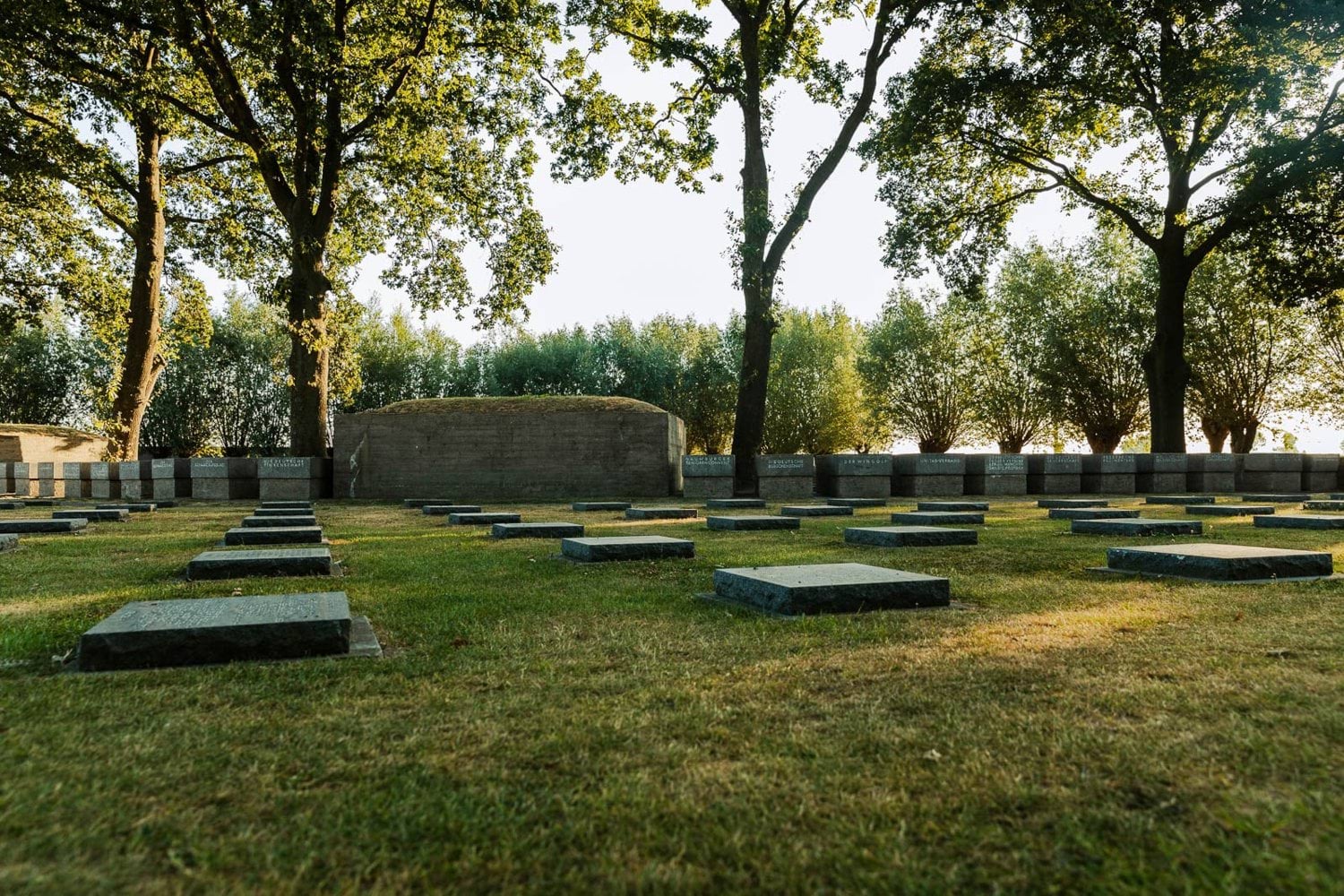
Visitors arriving from Tyne Cot often notice the contrast immediately. Commonwealth cemeteries usually use upright pale headstones, open lawns, the Cross of Sacrifice and, at larger sites, the Stone of Remembrance. Langemark uses darker stone, low markers, mature trees and a much heavier architectural atmosphere.
The difference should not be reduced to “Allied white versus German black.” Cemetery design emerged from different institutions, post-war political circumstances, budgets, land arrangements and commemorative traditions. Britain and its empire emerged among the victors and created the Imperial War Graves Commission with permanent access to cemetery land. Germany faced defeat, political upheaval and different financial conditions. Its cemetery system evolved under those constraints.
German dead in Belgium after 1918
At the end of the war, German graves were scattered through hundreds of burial places across Belgium. Some lay in German cemeteries, some in mixed cemeteries and others in isolated graves. Over time, remains were concentrated into a much smaller number of permanent German cemeteries.
In Belgian Flanders, the best-known surviving German cemeteries include Langemark, Vladslo, Menen and Hooglede. This concentration process explains why the number of dead at Langemark is vastly greater than the number originally buried there during the war.
The cemetery began in 1915
The Volksbund records that the site originated in 1915. It was therefore a wartime burial place before becoming the vast cemetery seen today. After the war and especially during later concentration programs, thousands more German dead were brought here.
This is important when interpreting any large cemetery. The men buried at Langemark did not all die within the present cemetery boundary or even in the same battle. Their graves represent a much wider geography of German loss in Flanders.
The First Battle of Ypres and the German offensive of 1914
In October and November 1914, German forces attempted to break the Allied line around Ypres during the final phase of the “Race to the Sea.” The fighting involved experienced active regiments, reserve formations and newly raised units that included many volunteers.
German losses were severe. Attacks around Langemark, Bikschote, Gheluvelt and other sectors collided with British, French and Belgian resistance. The battlefield was still more mobile than it would become later, but machine guns, rapid-firing artillery and rifles already made frontal movement extraordinarily dangerous.
Who were the “student soldiers”?
The traditional label Studentenfriedhof, or student cemetery, has encouraged generations of visitors to imagine that Langemark is filled mainly with university students. That is misleading. Some young volunteers were students or had recently been in education, but the regiments involved were socially mixed. They included reservists, tradesmen, clerks, workers and men from many backgrounds.
The myth grew because “students” made a powerful symbol: educated patriotic youth sacrificing themselves for Germany. The reality of a mass army was less tidy than the later national image.
10 November 1914 and the making of the Langemarck Myth
A particularly costly German attack took place near Langemarck on 10 November 1914. The following day the German Supreme Army Command issued a communiqué portraying young regiments as having advanced west of Langemarck while singing Deutschland, Deutschland über alles.
The image was emotionally powerful and politically useful. It transformed a costly battlefield episode into a story of voluntary youthful sacrifice. Yet historians have long questioned the literal details. Singing in organized fashion during a chaotic attack under artillery and machine-gun fire is difficult to reconcile with the battlefield conditions, and the units were not simply battalions of students.
Why propaganda needed Langemarck
In 1914 Germany, as in every belligerent country, the state and press had to explain enormous casualties to civilians. The war had been expected by many to be shorter than the reality emerging in Flanders. A story of idealistic young volunteers willingly sacrificing themselves gave meaning to loss.
This is one of the most instructive things about Langemark. Battlefield memory begins while the battle is still happening. Governments, newspapers, regiments and families immediately start creating narratives about what the deaths mean.
The myth after the First World War
The Langemarck story did not disappear after defeat. During the Weimar period it remained part of nationalist remembrance. In the 1930s the Nazi regime appropriated the language of youthful sacrifice and used Langemarck within its own political culture.
That later use does not mean every family visiting the cemetery shared Nazi ideology. It does mean the site acquired political layers beyond the men buried there. Modern interpretation has to distinguish the dead of 1914 from the later movements that used their memory.
The Kameradengrab: 24,917 men in one grave
The central mass grave is the most overwhelming numerical fact at Langemark. The Volksbund records 24,917 dead in the Kameradengrab. It is the largest mass grave at a German military cemetery.
A mass grave on this scale developed through concentration and the difficulty of individual identification. Names known to the cemetery administration are recorded on plaques, but physical separation into individual grave plots was impossible for many of the remains gathered here.
It is a stark contrast with the individualized upright headstone system used by the Commonwealth War Graves Commission.
The Mourning Soldiers
Near the mass grave stand four bronze figures by Munich sculptor Emil Krieger. Their posture is restrained. They look toward the grave rather than outward in triumph.
The figures help shift the emotional language away from battlefield glory. They are mourners. In a cemetery burdened by the earlier mythologizing of heroic youth, that later emphasis on grief is significant.
The dark stone markers
Low dark markers carry multiple names. The visual effect is communal rather than individually monumental. A visitor has to look down and move slowly along the ground to read them.
Design influences behaviour. Tyne Cot opens into broad vistas and ranks of pale headstones. Langemark draws the eye downward and inward. Both are carefully designed remembrance landscapes, but they communicate differently.
The oak trees
Mature oak trees contribute strongly to the cemetery's atmosphere. Oaks have deep symbolic associations in German culture, but at Langemark their practical effect is just as important. Shade, roots, fallen leaves and enclosed sightlines create a woodland cemetery rather than an open lawn.
On a wet winter day the site can feel very dark. In summer the same trees create a green canopy. The physical experience changes with the season.
Langemark and the Second Battle of Ypres
The cemetery also lies close to the sector associated with the first large-scale chlorine gas attack on the Western Front on 22 April 1915. The gas-release line extended across the northern Ypres battlefield near Langemark and Steenstrate.
This means the site connects two different years: the German volunteer myth of 1914 and the chemical warfare revolution of 1915. Visitors should not collapse them into one event.
German casualties are part of the Ypres story
English-language battlefield tourism naturally focuses heavily on Commonwealth soldiers because CWGC cemeteries, family records and national memorials dominate the landscape. Langemark corrects that imbalance.
The German army also lived for years in flooded trenches, endured artillery, lost men to disease and wounds, and buried its dead. Understanding the war requires seeing the battlefield from both sides without pretending the political causes of the conflict were identical or irrelevant.
Langemark and reconciliation
Modern German war-grave work emphasizes peace, reconciliation and historical education. The cemetery is not presented today as a shrine to nationalist sacrifice. Its historical burden makes that shift particularly important.
Students from different countries visit, youth work camps have helped maintain German cemeteries, and the site's interpretation increasingly explains propaganda rather than repeating it.
UNESCO World Heritage status
In 2023 a transnational group of First World War funerary and memory sites along the Western Front was inscribed on the UNESCO World Heritage List. Langemark is part of that wider commemorative landscape.
The inscription recognizes that cemeteries and memorials are not merely national monuments. Together they form an international cultural landscape created by the unprecedented mass death of industrial war.
Compare Langemark with Tyne Cot
The two cemeteries are close enough to visit on the same battlefield day and should be deliberately compared. Tyne Cot contains individual Commonwealth headstones, the Cross of Sacrifice, a vast memorial to the missing and surviving German bunkers. Langemark uses low markers, a mass grave and a darker woodland design.
Ask the same questions at both sites. How are individuals named? What does the architecture say about national identity? How were graves concentrated? How does the visitor physically move through the space?
The comparison teaches more about remembrance than either site alone.
Avoid two common mistakes
The first mistake is saying that all or most men at Langemark were students. They were not. The second is repeating the 1914 singing-charge story as simple fact. The story is historically important because it became propaganda, not because every detail can be accepted literally.
Correcting those myths does not make the deaths less moving. It respects the actual men rather than forcing them into a later national legend.
How long to spend at Langemark
Allow at least 30 to 45 minutes. The site is compact, but its history is dense. Walk the entrance axis, read the mass-grave names, study the low grave markers and spend time near the mourning figures.
If you are combining Langemark with Second Ypres, continue toward the St Julien Canadian Memorial and Essex Farm. If you are comparing remembrance, continue toward Tyne Cot.
Practical visitor advice
Langemark is a military cemetery and should be treated as a place of burial. Keep voices low and avoid using the dramatic atmosphere as a backdrop for inappropriate photographs. The cemetery is maintained by the Volksbund.
For German family research, use the Volksbund grave-search database before visiting. Not every individual name appears on a separate grave marker because of the mass grave and concentration history.
Guide's perspective: Langemark is at its strongest when you explain the myth before the visitor reaches the mass grave. The cemetery then becomes not only a place of death but a lesson in how nations remember, simplify and sometimes exploit their dead.
Frequently asked questions
How many German soldiers are buried at Langemark?
The Volksbund records 44,304 German dead at Langemark.
How many men are in the mass grave?
The Kameradengrab contains 24,917 dead, the largest mass grave in a German military cemetery.
Was Langemark really a cemetery for students?
No. Some of the young volunteers who fought in 1914 were students, but the regiments and the cemetery population were much more socially diverse. 'Student cemetery' is a misleading shorthand.
Did German students charge while singing in 1914?
A German wartime communiqué created the famous image of young regiments advancing while singing. Historians treat the literal story with caution. Its importance lies largely in the propaganda myth that developed around it.
Why does Langemark look different from British cemeteries?
German and Commonwealth cemetery systems developed under different post-war political, financial and commemorative conditions. Langemark uses low dark markers, trees and a mass grave rather than the CWGC system of individual upright headstones and open lawns.
Is Langemark connected with the first gas attack?
Yes. The cemetery lies close to the northern Ypres battlefield where German chlorine gas was released on 22 April 1915, although the cemetery's famous 'student' myth belongs mainly to the 1914 fighting.

Private Flanders Fields Battlefield Tour
Compare German and Commonwealth remembrance while connecting Langemark with the 1914 fighting, the Second Battle of Ypres, St Julien, Essex Farm and Tyne Cot.
Private tour for your group. Current seasonal price and availability are shown on the tour page.
Check AvailabilityWritten by Niels Declercq, private WW1 battlefield guide based in Bruges.