
Thiepval Memorial: The Missing of the Somme, the Battlefield and How to Visit
↓ Jump straight to planning a private Somme battlefield tour
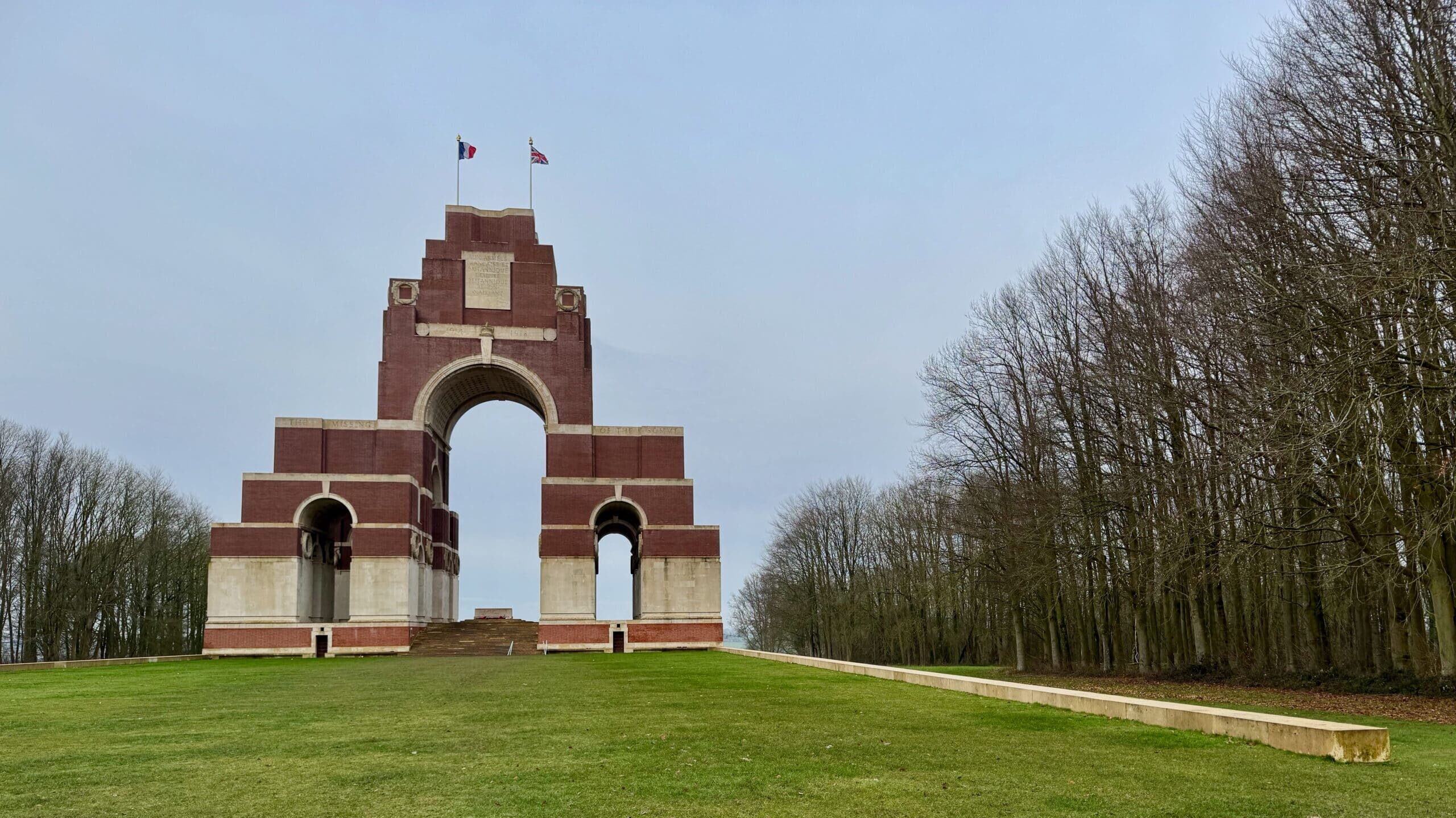
The Thiepval Memorial to the Missing of the Somme is the largest Commonwealth War Graves Commission memorial to the missing in the world. Designed by Sir Edwin Lutyens and completed in 1932, the 45-metre-high structure stands on the ridge where German defences resisted the British attack on 1 July 1916. Its sixteen great piers carry more than 72,000 names of British and South African servicemen who died on the Somme and have no known grave.
Thiepval is powerful because architecture and battlefield geography overlap. The memorial does not stand at a convenient visitor centre miles from the fighting. It occupies the ground of one of the strongest German positions on the opening day. Beside it, an Anglo-French cemetery contains 600 graves, deliberately pairing British and French dead. To understand Thiepval, visitors should therefore read three things at once: the missing names, the 1916 battlefield and the post-war attempt to create a shared monument out of industrial-scale loss.
- Location: Thiepval ridge above the River Ancre, Somme, France
- Architect: Sir Edwin Lutyens
- Height: About 45 metres
- Construction: Began in 1928 and took four years
- Commemoration: More than 72,000 British and South African missing of the Somme
- Anglo-French Cemetery: 600 graves, divided equally between Commonwealth and French dead
- Main battlefield connection: German strongpoint on 1 July 1916 and later fighting for Thiepval and the Schwaben Redoubt
Why Thiepval stands on a ridge
The first thing to notice is elevation. Thiepval occupies high ground overlooking the Ancre valley. From here German defenders could observe British positions and movement across the approaches.
The village and nearby redoubts formed part of a deep defensive system. Capturing Thiepval would open routes toward later objectives and remove observation from the Germans.
Thiepval before 1916
Before the war Thiepval was a small French village. German troops occupied the area during the fighting of 1914 and transformed the ridge into a fortified zone.
Trenches, dugouts and redoubts spread through the surrounding fields. The village itself became part of the defensive system rather than a normal civilian settlement.
The Schwaben Redoubt
North of the village lay the Schwaben Redoubt, one of the best-known German positions on the Somme. It consisted of trenches, shelters and strongpoints positioned to dominate the approaches.
On 1 July some British troops penetrated parts of the redoubt, but the gains could not be held. German counter-attacks restored much of the position.
Why the preliminary bombardment did not eliminate the defence
German dugouts in the chalk could be deep enough to shelter soldiers from much of the British bombardment. When the shelling moved forward, survivors climbed back to firing positions.
Wire also survived in places. Infantry advancing up the slope then met machine guns and rifle fire from a defence that British planners had hoped would be shattered.
1 July 1916 around Thiepval
The British attack in this sector was carried out largely by the 32nd Division, with the 36th (Ulster) Division attacking farther north toward the Schwaben Redoubt.
Results were mixed at local level but disastrous overall. Some units entered German positions. Others were stopped in no-man's-land. Without secure flanks and reinforcement, isolated gains became impossible to sustain.
The Ulster Division
The 36th (Ulster) Division achieved one of the most notable penetrations of German positions on the northern British front. Men reached and entered the Schwaben Redoubt.
They advanced farther than troops on neighbouring sectors, but the salient they created could not be supported effectively. German counter-attacks eventually forced survivors back.
The Ulster Tower nearby commemorates the division and is an essential companion site to Thiepval for visitors interested in Ireland's First World War story.
Why the village was not captured on 1 July
Thiepval's defences survived well enough to stop the main British effort. The village, ruins and trench systems continued to be fought over during the following months.
The failure shows why the Somme lasted until November. The first day did not break the German system, so the Allies had to attack successive positions in smaller operations.
September: Thiepval finally falls
The village was captured during the Battle of Thiepval Ridge in late September 1916. By then the front had moved through weeks of fighting farther south and east.
Artillery methods, objectives and experience had changed since July. The capture does not erase the opening-day failure, but it shows the campaign evolving.
The missing of the Somme
Industrial warfare created missing soldiers on a scale difficult to imagine today. Bodies could be obliterated by shellfire, buried in collapsed trenches, lost during later fighting or recovered after the war without sufficient evidence for identification.
Others were buried in temporary graves whose markers disappeared. A serviceman could be known to have died while his physical resting place remained unknown.
Those men required a form of commemoration different from a cemetery headstone.
Why build one enormous memorial?
After the war the Imperial War Graves Commission had to commemorate tens of thousands of missing men on the Western Front. Large memorials were created in areas associated with particular campaigns.
Thiepval became the principal memorial for the missing of the Somme. Its scale reflects the number of names it had to carry.
Sir Edwin Lutyens
Lutyens was one of Britain's most prominent architects and also designed the Cenotaph in Whitehall. At Thiepval he created a structure of interlocking arches and massive brick piers faced partly with stone.
The design avoids statues of charging soldiers or scenes of battle. Instead, the structure itself creates monumentality while the names provide the human content.
Sixteen piers of names
The names are inscribed on stone panels attached to the sixteen supporting piers. They are organized by regiment and then by rank and surname.
Visitors searching for a relative should bring the exact pier and face reference from the CWGC database. The memorial is too large to search efficiently by walking at random.
Why exact name totals can change
Older guidebooks and websites may give slightly different totals for Thiepval. This can happen because names are removed when a previously missing serviceman is identified in a grave, and new commemorations can occasionally be added after research.
For that reason the most reliable wording is “more than 72,000 names” unless using a current CWGC figure checked at the time of publication.
The date range of the memorial
The memorial commemorates British and South African servicemen who died in the Somme sector and have no known grave, covering fighting from 1915 through 20 March 1918.
This means not every name belongs to the 1916 Battle of the Somme. The geographic commemorative area continued to produce casualties before and after the famous campaign.
Why Canadians are not generally on Thiepval
Canadian missing from the Somme are primarily commemorated on the Vimy Memorial rather than Thiepval. Newfoundland also has its own memorial system and caribou sites.
This is a useful example of how Commonwealth commemoration was divided by nationality and memorial policy rather than only by exact battlefield location.
The Anglo-French Cemetery
On the western side of the memorial lies a cemetery containing 600 graves: 300 Commonwealth and 300 French. The cemetery was deliberately created as a symbol of the alliance that fought on the Somme.
Many of the graves are unidentified. British stones may read “Known unto God”, while French crosses use the equivalent identification as unknown.
Why the cemetery is unusual
Most Commonwealth cemeteries are overwhelmingly British Empire burial sites, even when French cemeteries lie nearby. Thiepval intentionally brings the two allies together.
The arrangement reminds visitors that the Somme offensive was originally a joint Anglo-French battle, even though British memory often dominates the northern battlefield today.
The memorial was not completed immediately after the war
Construction began in 1928 and took four years. The memorial was unveiled in 1932 by the Prince of Wales in the presence of the French president.
The long delay reflects the enormous practical challenge of designing, financing and building permanent commemorative landscapes after a war that had left hundreds of thousands of graves and missing men.
The visitor centre
Modern interpretation at Thiepval includes a visitor centre and museum space explaining the battle, archaeology, the missing and the memorial.
It is useful before or after walking the memorial, but visitors should still spend time outside looking across the ridge. Thiepval's battlefield position cannot be understood indoors.
Look toward the River Ancre
From the ridge, orient yourself toward the Ancre valley and Beaumont-Hamel. The shape of the ground helps explain why separate British attacks on 1 July influenced each other.
An advance could not succeed in isolation if neighbouring German positions remained intact and could fire onto its flank.
The memorial and battlefield archaeology
Archaeological work around Thiepval has helped recover trench lines, artefacts and human remains. The ground still contains evidence of the battle beneath modern grass and farmland.
When remains are discovered, specialist teams attempt identification using physical evidence, records and sometimes DNA. The work shows that the category “missing” can still change more than a century later.
Names removed from memorials
If a missing soldier is later identified in a known grave, his commemoration may be corrected. The memorial panel can be altered and cemetery records updated.
This is why war-grave databases are living records rather than frozen 1920s documents.
One name instead of 72,000
The scale can overwhelm visitors. A useful method is to research one individual before arriving. Find his age, battalion, home town and date of death.
Then locate the panel. One life makes the surrounding thousands easier to comprehend without reducing them to statistics.
Thiepval and the Pals battalions
Many battalions on the Somme contained wartime volunteers recruited from local communities. Their losses created concentrated grief at home.
The memorial names therefore map onto British social history. Behind one panel can lie a factory, mining town, school or neighbourhood whose young men enlisted together.
Thiepval and the Somme film
The 1916 film The Battle of the Somme brought images of the offensive to British audiences during the campaign. The film helped shape how civilians imagined the battlefield.
Thiepval today plays a related role in memory: it gives a physical form to an absence too large to visualize from photographs alone.
How long to spend
Allow at least 45 minutes for the memorial and cemetery. An hour to ninety minutes is better if you include the visitor centre, family-name research and battlefield orientation.
Combine Thiepval with Beaumont-Hamel and the Ulster Tower for the northern first-day story, or with Pozières and Lochnagar for a broader Somme overview.
Practical advice for finding a name
Search the CWGC database before travelling and save the pier and face reference. Mobile reception can be inconsistent and the panels are extensive.
Arrive outside the busiest coach periods if you want quiet time with a family name. Early morning and late afternoon often provide a very different atmosphere from midday.
Why Thiepval matters
The memorial is not simply a list of men “with no grave”. It is evidence of what artillery warfare did to the basic human expectation of burial and identification.
The men on the walls died in different battles and years, but they share one fact: their families had no identified grave to visit. Thiepval became that place.
Guide's perspective: stand outside before entering the arches. Explain the German ridge first. Then enter and find one name. Finally walk to the Anglo-French Cemetery. In fifteen minutes the site moves from battlefield, to individual loss, to international remembrance.
Frequently asked questions
How many names are on the Thiepval Memorial?
The memorial carries more than 72,000 names of British and South African servicemen who died in the Somme sector and have no known grave. Exact totals can change slightly as identifications and records are corrected.
Who designed the Thiepval Memorial?
Sir Edwin Lutyens, who also designed the Cenotaph in London.
How tall is Thiepval Memorial?
Current CWGC visitor material describes the memorial as about 45 metres high.
What is the cemetery behind the memorial?
The Anglo-French Cemetery contains 600 graves, 300 Commonwealth and 300 French, many of them unidentified.
Was Thiepval captured on 1 July 1916?
No. German forces held the village on the opening day. British troops captured Thiepval during the Battle of Thiepval Ridge in late September 1916.
How do I find a relative's name?
Use the CWGC database before visiting and note the pier and face reference. Names are organized by regiment, rank and surname.

Private Somme & Northern France Battlefield Tour
Visit Thiepval as part of the battlefield rather than as an isolated monument, connecting the names with Beaumont-Hamel, the Ancre valley, Pozières and the opening day of the Somme.
Private full-day tour for your group. Current seasonal price and availability are shown on the tour page.
Check AvailabilityWritten by Niels Declercq, private WW1 battlefield guide based in Bruges.