The Australian Trail on the Western Front: Pozières, Bullecourt, Villers-Bretonneux and Le Hamel
↓ Jump straight to planning your private battlefield tour
The Australian Trail on the Western Front follows the AIF through some of its most important battlefields in Northern France: Fromelles, Pozières, Bullecourt, Villers-Bretonneux and Le Hamel. These places tell very different stories. Fromelles in July 1916 was a disastrous introduction to major Western Front battle. Pozières became an artillery ordeal. Bullecourt exposed the problems of attacking the Hindenburg Line. Villers-Bretonneux and Le Hamel in 1918 show an increasingly experienced Australian Corps using far more sophisticated combined-arms methods.
A single day should not try to cover every Australian battlefield from Lille to Amiens. The distances are too large for serious interpretation. The private route is therefore selected around your main interests, family history and starting point. A two-day combination with the Australian Flanders Fields route is the strongest way to connect Polygon Wood and Passchendaele with Northern France.
- Format: Private full day
- Core battlefields: Pozières, Bullecourt, Villers-Bretonneux, Le Hamel and Fromelles
- Group: Up to 6 guests
- Pickup: Bruges or Ypres
- Family history: AIF records can shape the route
- Best deeper option: Two days when combining Northern France with Australian Flanders Fields
What this private tour is designed to do
The Australian Trail is built around understanding rather than collecting stops. The day follows the changing Australian experience from the brutal learning curve of 1916 to the increasingly coordinated operations of 1918.
Because the vehicle is private for your group, the pace can change when a family grave, memorial name or battlefield feature deserves more time.
Why route design matters
Australian Western Front sites stretch from Fromelles near Lille to Villers-Bretonneux near Amiens. That geographic spread makes route selection essential.
The strongest route therefore follows one historical and geographic line. That avoids crossing the same countryside repeatedly and leaves enough time to walk the ground rather than view it through a windscreen.
Possible sites
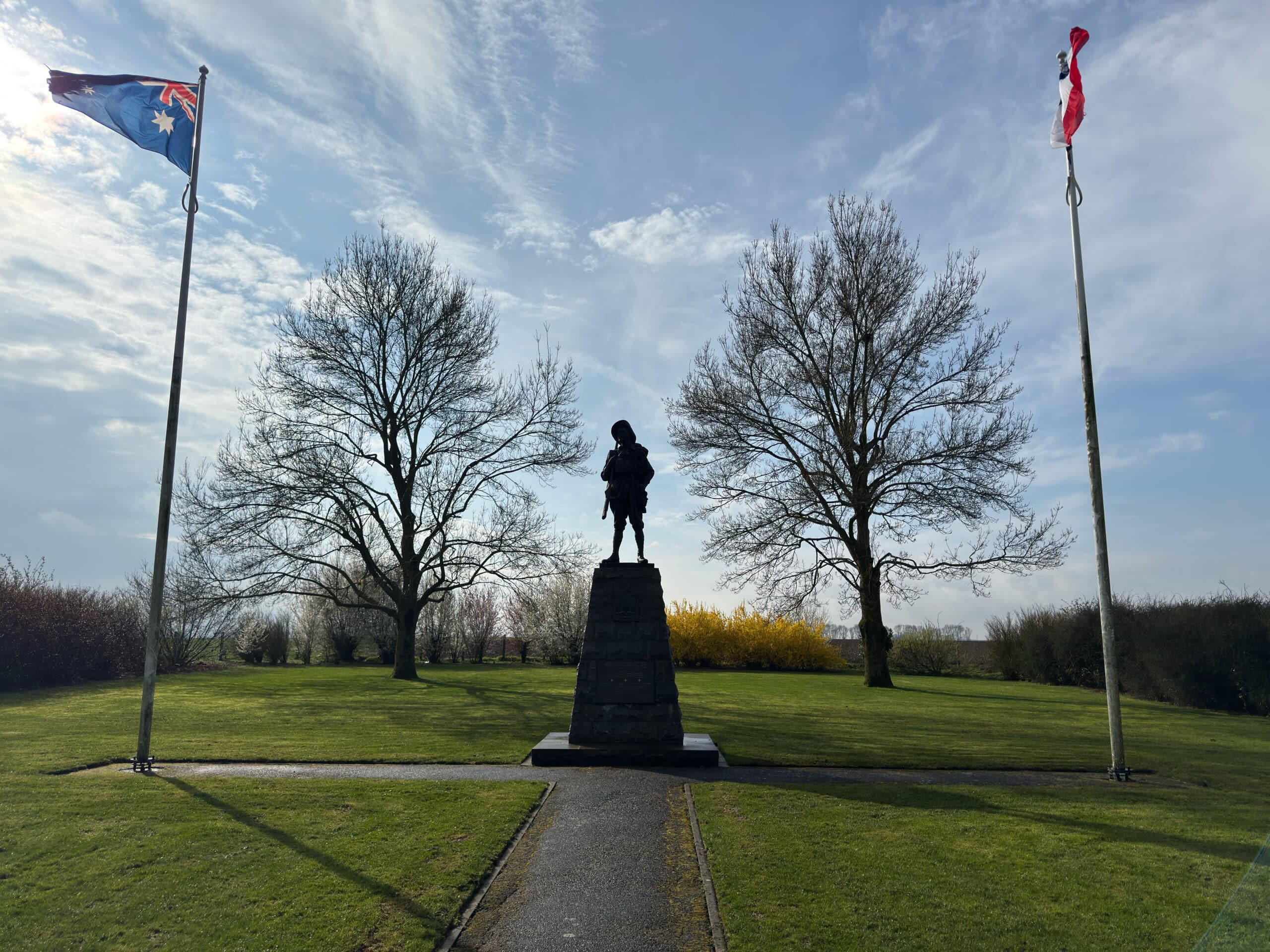
Possible stops include Pozières Windmill, Mouquet Farm, the Bullecourt Digger, Villers-Bretonneux, the Sir John Monash Centre, Le Hamel and Fromelles.
Not every site belongs in every itinerary. The exact sequence is chosen around your main interests, starting point, available daylight, museum priorities and family history.
Family-history research
If the day follows a relative, send the full name, service number, battalion or unit, date of death and any family documents before the tour. Battalion-level information is especially important because one regiment could contain several battalions serving in completely different sectors.
War diaries, cemetery records and trench maps can often connect the man to a road, trench line or objective even when he has no known grave.
How terrain is interpreted
The battlefield is explained from the ground outward. Ridges, valleys, roads, canals and villages are identified first, then unit movements and personal stories are placed onto that geography.
This is particularly important in Northern France because farming and reconstruction have removed most surface trenches. The shape of the land often preserves more military meaning than the visible monuments.
Cemeteries and memorials
A named cemetery grave and a memorial to the missing answer different questions. A grave marks an identified burial. A memorial panel names someone whose identified grave does not exist.
Learning to distinguish those forms of remembrance helps visitors read sites such as Thiepval, Vimy and Villers-Bretonneux rather than treating all memorial architecture as equivalent.
Museums and visitor centres
Museums can add depth, especially for first-time visitors, but indoor interpretation takes substantial time out of a full-day route. One strong museum is usually more useful than several rushed visits.
The route can be adjusted around weather and interest. Visitors already familiar with the campaign often prefer to spend more time on the battlefield itself.
Lunch and breaks
A long day works better with a realistic break in a practical town such as Albert, Arras or another point along the route. Trying to eat in the vehicle while adding one more site rarely improves the experience.
Meals and museum admission are separate unless a booking explicitly states otherwise.
What to bring
Comfortable shoes and weather-appropriate layers are essential. Many sites involve wet grass, uneven cemetery paths or exposed ridges.
Bring family records, photographs and saved memorial references. Download important documents in advance because rural mobile coverage can be inconsistent.
Photography and respectful access
Photography is welcome at most public battlefield sites, but cemeteries remain places of burial. Do not climb on monuments, cross into private fields or disturb battlefield objects.
Drone rules vary by location and memorial authority. Permission should never be assumed.
Starting from Bruges or Ypres
Bruges and Ypres are practical pickup points, but Northern France requires a long transfer compared with the Ypres Salient. An early departure protects the quality of the battlefield time.
Custom pickup can be discussed when it makes geographic sense, especially for guests already staying around Arras or the Somme.
Why a full day is the minimum
Driving, parking, walking, historical explanation and family-name searches all consume time. Northern France becomes rushed very quickly if the day is treated like a half-day Ypres route.
A full day gives several major sites enough space to connect into one narrative. Two days are better when combining distant sectors.
What a good battlefield day should achieve
By the end of the day you should be able to explain what the armies were trying to achieve, why the ground mattered and how the memorials relate to the fighting.
That is a better measure of value than the number of places visited.
Fromelles, 19–20 July 1916
The Australian 5th Division entered its first major Western Front action at Fromelles. The attack failed and the Australian War Memorial records 5,533 casualties in less than twenty-four hours.
VC Corner, the Cobbers Memorial and Pheasant Wood Cemetery allow the battle to be interpreted through both the 1916 attack and the much later recovery of missing soldiers.
Pozières
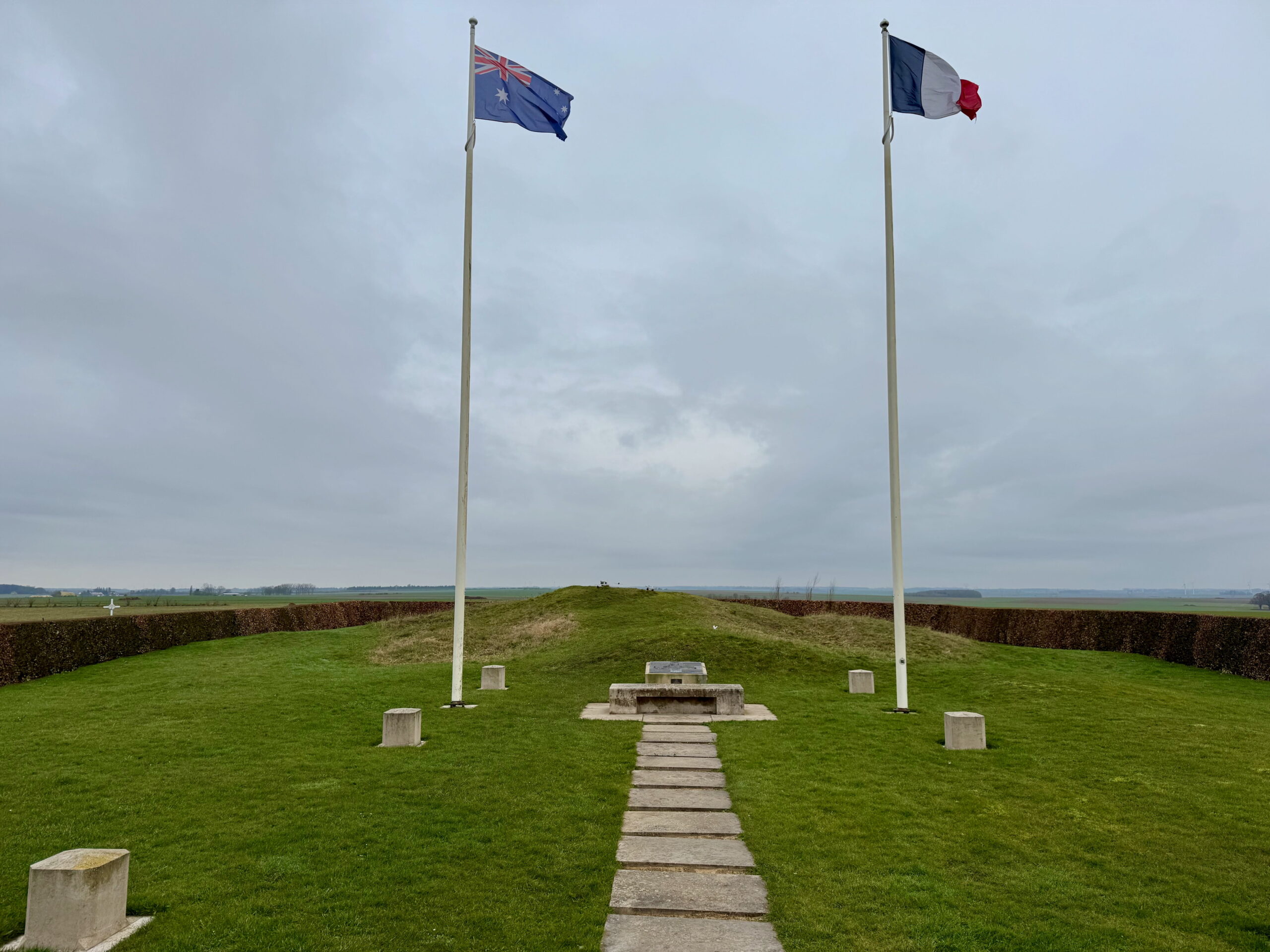
Four days after Fromelles, the 1st Australian Division attacked Pozières. The 1st, 2nd and 4th Divisions then fought repeated tours for the village, ridge and approaches to Mouquet Farm.
The Australian War Memorial records about 23,000 casualties over forty-two days, including around 6,800 killed or dead of wounds.
Why the ridge mattered
Pozières was important because it sat on high ground along the Albert-Bapaume road. Observation over the surrounding battlefield made the ridge valuable to both sides.
The Windmill Site is therefore strongest when explained as terrain first and memorial second.
Bullecourt and the Hindenburg Line
In April and May 1917 Australians attacked the new German Hindenburg Line around Bullecourt. The first attack depended partly on tanks that failed to provide the expected support and ended disastrously.
The second battle eventually secured ground but at heavy cost. Bullecourt became one of the AIF's most controversial Western Front experiences.
Villers-Bretonneux
During the German Spring Offensive of 1918, Villers-Bretonneux became crucial because of its position east of Amiens. German forces captured the village before Australian and British troops counter-attacked during the night of 24–25 April.
The Australian National Memorial now stands nearby. The Department of Veterans' Affairs currently records 10,770 Australian servicemen named there who died in France and have no known grave.
The Sir John Monash Centre
The modern centre behind the memorial provides a detailed interpretation of Australia's Western Front experience through personal accounts and digital media.
It is worth significant time, so a route that includes it should deliberately remove other stops rather than simply add the centre to an already full list.
Le Hamel, 4 July 1918
At Le Hamel General John Monash coordinated infantry, tanks, artillery and aircraft in a short, carefully timed operation. American troops also participated.
The battle became an important example of the combined-arms methods used increasingly during the final year of the war.

Australian Flanders Fields
Polygon Wood, Broodseinde and Passchendaele belong to the Australian story in Belgium. They are geographically separate from the Northern France route.
A two-day programme allows 1917 Flanders to be compared properly with the Somme, Bullecourt and 1918 without turning both regions into one rushed day.
Cancellation policy
Cancellation is free up to 7 days before the tour. This policy is stated directly on the tour page so the booking conditions are clear before you reserve.
Fromelles and Pozières should not be blended together
The two battles happened only days apart but were very different operations. Fromelles was a diversionary attack in northern France involving the Australian 5th Division. Pozières was part of the continuing Somme offensive and eventually involved three Australian divisions fighting for a strategically important ridge.
Keeping those contexts separate makes the scale of July 1916 easier to understand and prevents every Australian loss in France from being labelled simply “the Somme”.
Bullecourt and the problem of tanks
The first Bullecourt attack has become strongly associated with the failure of tanks to provide the support expected. The lesson is not that tanks were useless. In 1917 the technology was still immature and reliability poor, while infantry and tank cooperation was still developing.
By 1918 Australian operations looked very different because tanks, artillery and infantry were being integrated more carefully.
Villers-Bretonneux and Anzac Day
The counter-attack of 24–25 April 1918 gave Villers-Bretonneux a special place in Australian remembrance because the village was retaken on Anzac Day. Local French memory and Australian national memory became closely connected after the war.
The Australian National Memorial and the nearby school tradition make this one of the clearest places to see how battlefield memory can become a long-term relationship between communities.
Victoria School and 'Do Not Forget Australia'
Money raised in Victoria helped rebuild the school at Villers-Bretonneux after the war. The continuing Australian connection is visible in school remembrance and local symbols.
This civilian relationship broadens the battlefield story beyond military operations and shows how post-war reconstruction became part of commemoration.
Le Hamel and John Monash
Le Hamel is often used to illustrate Monash's methodical planning because artillery, tanks, aircraft and infantry were coordinated around a short timetable. The battle achieved its objectives in roughly the period planned.
It should not be treated as a magical template that solved the Western Front alone, but it clearly shows the sophistication Allied armies had reached by mid-1918.
Australian service dossiers
Australian First World War service dossiers are among the strongest sources for family-history preparation. They can record enlistment, embarkation, wounds, hospital movements, promotions and casualty information.
Once the battalion and date are established, unit war diaries and operation reports can narrow the soldier's battlefield far more precisely.
Missing Australians in France
Many Australians killed on the Western Front have no known grave because artillery destroyed bodies, temporary graves disappeared or remains could not be identified after the war.
The Villers-Bretonneux Memorial names missing Australians from France, making it a national commemorative site rather than a list only of men killed in the 1918 battle around the village.
Booking and cancellation
The final route depends on geography. A Pozières and Villers-Bretonneux day is realistic, while adding Fromelles as well may turn the day into a long transfer between distant sectors.
Cancellation is free up to 7 days before the tour.
When the best Australian route is not the most famous one
A relative's battalion may lead to a small village, cemetery or approach trench rather than Pozières or Villers-Bretonneux. Australian service files and battalion diaries often make it possible to build a route around that less famous ground. A private day should prioritize that documented connection, then use major memorials to provide wider context instead of allowing the national monuments to dominate the itinerary automatically.
Frequently asked questions
What is the cancellation policy?
Cancellation is free up to 7 days before the tour.
Which Australian sites can be included?
Possible sites include Pozières, Mouquet Farm, Bullecourt, Villers-Bretonneux, Le Hamel and Fromelles.
Can the Sir John Monash Centre be included?
Yes, subject to opening hours and the time available.
How many Australians are named at Villers-Bretonneux?
The Australian Department of Veterans' Affairs currently records 10,770 servicemen named on the memorial.
Can Fromelles and Villers-Bretonneux be done properly in one day?
It is a very long route. A tighter geographic focus normally gives a better battlefield experience.
Can I trace an Australian ancestor?
Yes. AIF service dossiers and war diaries are excellent sources for building a personal route.
Can this tour be combined with Polygon Wood and Passchendaele?
Yes, but two days gives much more depth than combining Belgium and Northern France in one day.

Plan a Private Australian Western Front Tour
Choose the battlefields that matter most to you or build the day around an Australian relative.
Free cancellation up to 7 days before the tour.
Check AvailabilityWritten by Niels Declercq, private WW1 battlefield guide based in Bruges.