
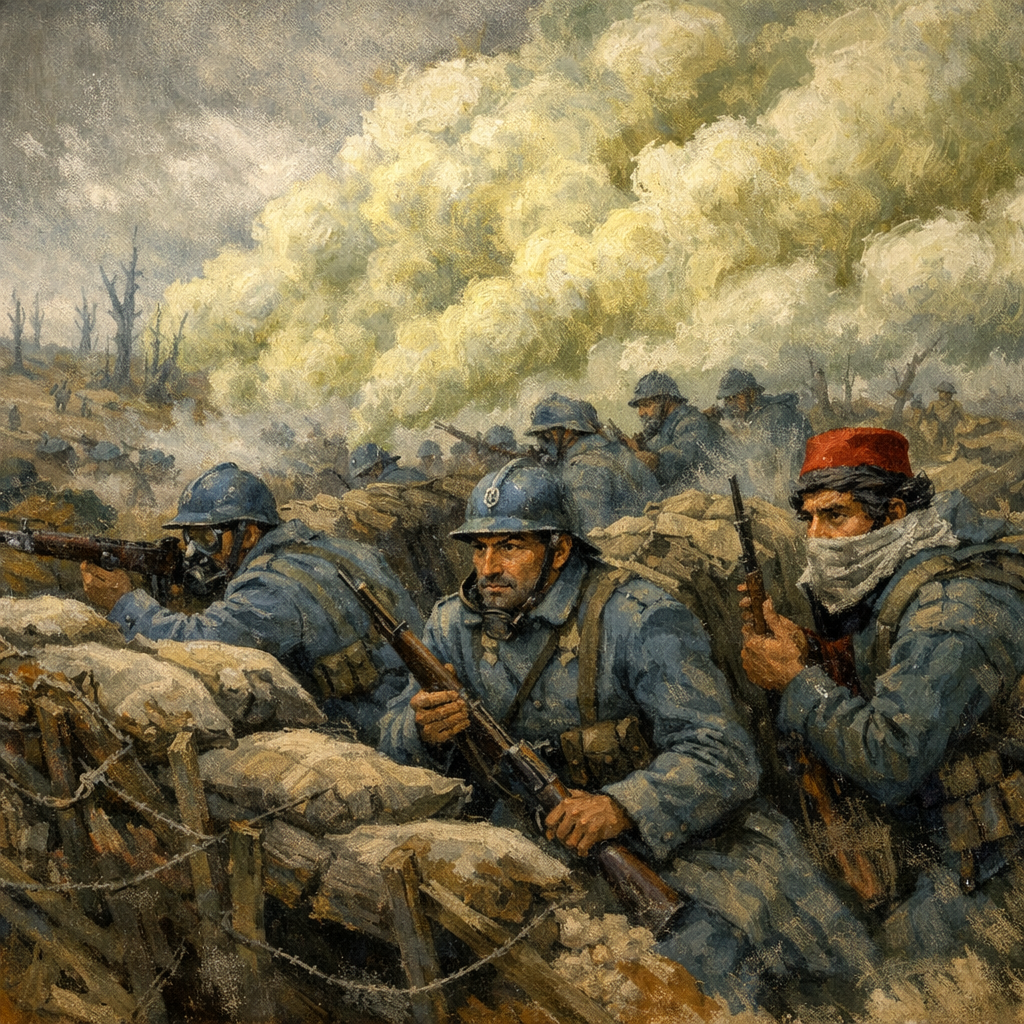
The French Army in Flanders Fields
The French Army was essential to the defence of the Ypres Salient in 1914 and 1915, but its role can be overlooked amid the many Commonwealth cemeteries and monuments. French metropolitan, territorial and colonial formations fought in Flanders. On 22 April 1915, a German chlorine release struck French-held positions north of Ypres, opening the Second Battle of Ypres and exposing the Canadian flank.

The story should not be reduced to the phrase that French troops simply “fled”. The men in the gas cloud had no effective protection against a new mass chemical weapon. French and North African soldiers died, withdrew, re-formed and continued fighting while Canadian units attempted to stabilize the exposed flank. The French presence remained important later in the war, including the defence of Kemmel in 1918. Saint-Charles-de-Potyze, the principal French military cemetery near Ypres, preserves that multinational history.
In this article
- France at First Ypres
- Colonial troops in Flanders
- 22 April 1915
- The gap beside the Canadians
- Avoiding the old ‘French fled’ stereotype
- The first large-scale chlorine attack
- How the battlefield changed after the gas attack
- Saint-Charles-de-Potyze
- Individual graves and ossuary burials
- French remembrance looks different
- French troops and the Yser
- The French Army in 1917
- French reserves return in 1918
- Reading the French contribution on the ground
- Why this story matters
France at First Ypres
French formations were deeply involved in the fighting that stopped German forces around Ypres in October and November 1914. As British regular units suffered catastrophic losses, French reinforcements helped hold sectors north and east of the city.
This matters because later British memorial dominance can make the 1914 battle look more exclusively British than it really was.
Colonial troops in Flanders
France drew soldiers from across its empire, including North Africa and West Africa. Units described in wartime sources as Algerian, Moroccan, Zouave or Tirailleur formations served on the Western Front alongside metropolitan French troops.
Their presence around Ypres makes the Salient part of a global imperial war, not a conflict fought only by Europeans.
22 April 1915
In the late afternoon of 22 April 1915, German forces released chlorine from cylinders opposite a sector held by French territorial and Algerian troops. Parks Canada’s battle account places these formations in the initial path of the cloud.
The cloud moved across positions held by French territorial and Algerian troops. With no effective gas masks, men suffered choking, blindness and panic while the German infantry advanced behind the cloud.
The gap beside the Canadians
The gas attack opened a serious gap on the left of the 1st Canadian Division. Canadian troops were suddenly required to defend their own front while also protecting an exposed flank.
This interaction is why the French and Canadian stories cannot be separated. The famous Canadian defence at Second Ypres was a response to the collapse of a neighbouring French sector under a weapon no army there had previously faced on that scale.
Avoiding the old ‘French fled’ stereotype
Older English-language accounts sometimes describe the French withdrawal in dismissive language. That framing ignores the physical effect of concentrated chlorine on troops without protection.
Some units disintegrated under the cloud, but the cause was not simple cowardice. A modern account should describe the weapon, the confusion and the tactical consequences rather than use nationality as an explanation.
The first large-scale chlorine attack
Chemical weapons had been experimented with earlier in the war, but 22 April 1915 marked the first successful large-scale use of chlorine on the Western Front.
The attack demonstrated that industrial chemistry could become a battlefield weapon. Within months both sides were developing gas protection and their own chemical capabilities.
How the battlefield changed after the gas attack
The German advance forced the Allies to shorten the Salient. The front moved closer to Ypres, making the city even more exposed to artillery.
Remaining civilians were driven out and the Salient became increasingly a purely military zone.
Saint-Charles-de-Potyze
The French national cemetery east of Ypres is the principal French burial site in the Salient. French remembrance authorities describe it as holding several thousand French dead gathered from the Flanders front.
The cemetery includes individual graves and an ossuary, reflecting the same identification problems seen across the Western Front.
Individual graves and ossuary burials
Different official pages and older guidebooks can show different totals because of reorganizations, record corrections and the distinction between individual graves and ossuary burials.
Individual graves and ossuary burials represent different outcomes of recovery and identification. The cemetery should be read in its own historical context, rather than treated as the casualty list of one nearby action.
French remembrance looks different
French military cemeteries follow national design conventions, including crosses and other markers appropriate to the people commemorated. The range of inscriptions also reflects the diversity of the French forces.
Comparing Potyze with a nearby Commonwealth cemetery makes national approaches to commemoration visible immediately.
French troops and the Yser
The French role extended north beyond the Salient. French naval infantry and other formations fought beside the Belgian Army during the Battle of the Yser in 1914.
This wider front protected the last unoccupied part of Belgium and helped stabilize the line from Nieuwpoort toward Ypres.
The French Army in 1917
British forces carried the main burden of the Ypres offensives in 1917, but French formations also participated in the broader Flanders operations and held sectors connected to the northern flank.
Remembering that contribution prevents the 1917 battlefield from being interpreted as a purely British imperial campaign.
French reserves return in 1918
During the German Spring Offensive in Flanders, French reserves were moved north to support the British. They became central to the defence of Kemmelberg in late April.
The French ossuary at Kemmel demonstrates how costly that intervention became.
Reading the French contribution on the ground
The French cemetery, the canal sector and the Kemmel battlefield reveal different periods of French involvement. They need to be connected chronologically rather than treated as evidence of one action.
These sites explain 1914 defence, 1915 chemical warfare and the return of major French fighting in 1918.
Why this story matters
Without the French Army, the Ypres Salient cannot be explained accurately. French forces were present when the line formed, were directly hit by the first large-scale chlorine attack and returned in strength during the crisis of 1918.
The modern dominance of Commonwealth memorials reflects post-war cemetery systems, not the complete wartime balance of forces.
Bring your questions to the battlefield.
Tell me your preferred date, group size, starting point and what you would like to understand. If you are following a relative, include the name and any service details you have.
I will explain what is possible, discuss any research needed and confirm the practical arrangements and group price before you book.
Prefer direct contact? Email Niels or ask on WhatsApp.
Lunch and drinks are separate. The Last Post is an optional evening extension agreed in advance.