
Published: 18 May 2026
Rebuilding Ypres After the First World War: Ruins, Reconstruction and Memory
↓ Jump straight to planning a private Flanders Fields tour
The medieval-looking centre of Ypres is largely a twentieth-century reconstruction built after the First World War. By 1918 the Cloth Hall, St Martin’s Cathedral and most streets in the historic centre had been reduced to ruins. The post-war question was not simply how to repair damaged buildings. It was whether Ypres should remain a permanent ruin, be rebuilt as a modern city, or recover the architectural identity it had before 1914.
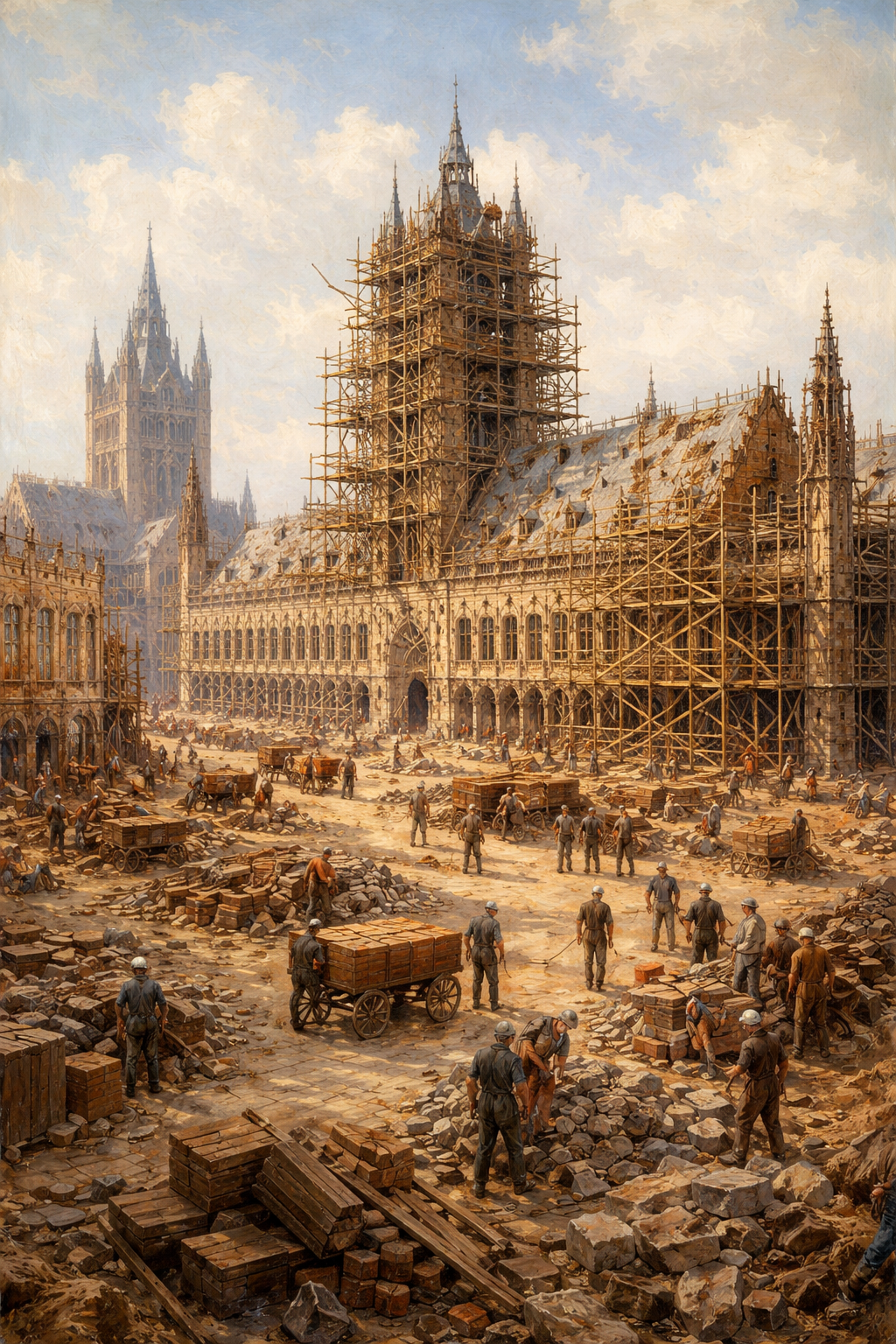
The residents chose reconstruction. Architect Jules Coomans, who knew the pre-war monuments intimately, became one of the central figures in rebuilding the city. Houses returned first, major public buildings followed and the Cloth Hall reconstruction continued for decades, reaching completion in 1967. The result is one of the most remarkable reconstructed historic cityscapes in Europe: Ypres is genuinely medieval in origin, but much of what visitors see is post-1918 masonry deliberately recreating an older city.
- Wartime result: Most of the historic centre destroyed
- Key reconstruction architect: Jules Coomans
- Main reconstructed monuments: Cloth Hall and St Martin’s Cathedral
- Cloth Hall completion: 1967
- New memorial architecture: Menin Gate, unveiled 1927
- Core visitor lesson: Modern Ypres is both an ancient city and a post-war reconstruction
What Ypres looked like in 1918
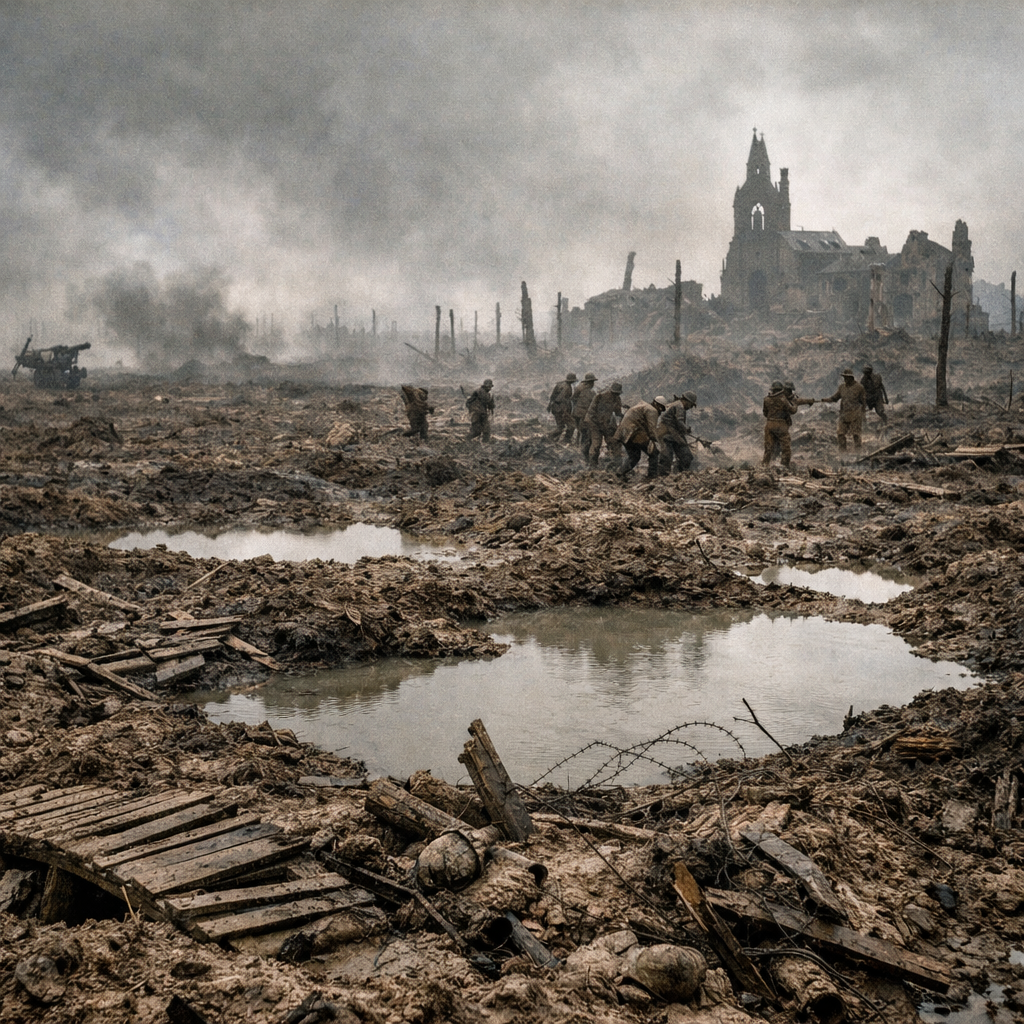
Four years of shellfire had destroyed most of the city. The Cloth Hall survived as a skeletal ruin, churches were shattered and entire streets had become piles of brick.
Photographs from the final war years are essential because the rebuilt modern centre otherwise makes the scale of destruction difficult to imagine.
The civilians had already been driven out
Ypres did not remain a functioning civilian city throughout the war. As artillery intensified and the front moved dangerously close in 1915, the remaining population was forced to leave.
The destruction therefore happened to a largely military landscape whose civilian owners were living elsewhere as refugees.
The first problem was housing
When inhabitants returned after the Armistice, they came back to ruins, unexploded ammunition and damaged infrastructure. Before grand monuments could be rebuilt, people needed roofs, water, roads and basic services.
Temporary wooden housing and emergency structures appeared while claims for war damage and reconstruction plans were processed.
King Albert’s Fund houses
Prefabricated emergency houses associated with the King Albert Fund were used across devastated Belgium. They were intended as temporary accommodation but some remained occupied much longer than expected because reconstruction took years.
Examples preserved in museums are useful because they tell the recovery story at family scale rather than only through monumental architecture.
Jules Coomans
Coomans had worked on Ypres monuments before the war and brought detailed knowledge of the city’s architectural fabric into the reconstruction period.
His role helped make historically styled reconstruction possible because planners were not starting from photographs alone. Pre-war drawings, restoration records and surviving fragments could all contribute.
Rebuild or modernize?
Not everyone automatically agreed that the old city should return. Rebuilding offered the possibility of wider streets, new architecture and a more modern urban plan.
Supporters of historic reconstruction argued that Ypres’s identity was inseparable from its medieval centre. Their approach ultimately shaped the Grote Markt and surrounding streets.
The British idea of preserving the ruins
Some British voices proposed leaving Ypres ruined as a permanent memorial to the war. Winston Churchill referred to the ruins as sacred ground in the post-war debate.
For local residents, however, Ypres was not merely a symbol of British sacrifice. It was their home, property and economic centre. The tension between international memory and local life is central to the reconstruction story.
The Cloth Hall
The medieval Cloth Hall had embodied Ypres’s importance in the medieval textile trade. Its wartime ruin became one of the iconic images of destruction on the Western Front.
Reconstruction was therefore both architectural and symbolic. Rebuilding the hall said that the city would not allow bombardment to erase its historic identity.
Why the Cloth Hall took so long
Large-scale reconstruction required money, skilled labour, stone, documentation and political commitment. Work continued through changing economic conditions and was interrupted by another world war.
The project was finally completed in 1967, almost half a century after the Armistice.
St Martin’s Cathedral
The cathedral was also rebuilt after severe wartime destruction. Its restored appearance contributes to the modern illusion that the historic centre survived more intact than it actually did.
Comparing pre-war, ruined and reconstructed photographs makes clear that reconstruction involved choices about silhouette and detail as well as simple replacement.
Private houses and reconstructed façades
Much of the Grote Markt and surrounding streets was rebuilt in styles intended to harmonize with the city’s historic character. Many façades look centuries old because that was exactly the intention.
Behind those façades, interiors could meet newer practical needs. Reconstruction was therefore not identical with archaeological replication.

The Menin Gate as new architecture
The Menin Gate was not a medieval structure reconstructed after destruction. It was a new memorial designed by Sir Reginald Blomfield and unveiled in 1927 on the route through which troops had moved toward the Salient.
This distinction is useful: post-war Ypres contains both reconstruction of lost architecture and completely new memorial architecture.
War tourism and reconstruction
Veterans, widows and battlefield pilgrims began visiting while the city was still being rebuilt. Hotels, cafés, guides and transport services developed around remembrance tourism.
The returning visitors brought money and international attention, but local residents were simultaneously rebuilding ordinary civic life.
The Last Post and the rebuilt city
The Last Post tradition began in the late 1920s and turned the Menin Gate into a repeated civic ritual rather than a static memorial.
The ceremony became part of the identity of reconstructed Ypres: a living town that stops every evening to remember an international war.
How to spot reconstruction today
Look at dates carved into façades, masonry changes and historical photographs. The Grote Markt is especially useful because the relationship between the Cloth Hall and surrounding houses is easy to compare with wartime images.
The goal is not to ‘catch out’ the city as fake. The reconstruction is itself the historic object.
Reconstruction across the Westhoek
Ypres was not unique. Villages across the Salient and wider Westhoek were rebuilt from devastation. Churches, farms and town centres often reproduce pre-war forms in twentieth-century materials.
That gives the region a visual coherence that is partly medieval inheritance and partly a post-war rebuilding programme.
What reconstruction tells us about memory
A preserved ruin says one thing about war: destruction should remain visible. Reconstruction says another: community life and identity should continue.
Ypres chose to rebuild while also creating memorials and museums. The city therefore holds both responses at once.
Guide’s perspective
Stand in the Grote Markt before showing any ruined photograph and ask visitors how much they think survived the war. Then show the Cloth Hall and street ruins. The gap between expectation and evidence is the most effective introduction to reconstruction.
How to read this battlefield today
Start with the landscape before the memorials. Identify the direction of the front, the important roads, the higher ground and the routes used to move men and supplies. Modern fields can hide wartime destruction, but the basic geometry of the countryside often survives.
Historical photographs and trench maps work best when used to answer a question about the ground in front of you. They should not replace looking at the battlefield itself.
What has changed since 1918
Most of the Westhoek was rebuilt, drained and returned to farming. Trenches collapsed, timber disappeared and shell holes were filled. Surviving bunkers, cemeteries and preserved sites are therefore fragments of a much larger wartime landscape.
That does not make the modern battlefield inauthentic. Roads, ridges, canals and village locations can still explain military decisions even when the surface has changed completely.
Using personal stories carefully
Personal stories are strongest when the person, unit and date can be documented. A letter or family tradition can add emotion, but it should not be used to invent an exact location or final moment that the surviving record cannot prove.
Where the evidence is uncertain, saying ‘we cannot know exactly’ is better history than turning a possibility into a dramatic certainty.
Planning this as part of a private day
These sites fit best when they are connected to a larger theme rather than inserted as unrelated stops. A medical story can lead naturally to a cemetery; a ridge can lead to an artillery story; a reconstructed city can lead to remembrance and the Menin Gate.
A private day allows time to change emphasis without losing that structure. Current prices remain on the live booking page rather than in evergreen historical copy.
Why reconstruction is not the same as falsification
A reconstructed building can still carry authentic historical meaning. The decision to rebuild the Cloth Hall in its historic form was itself a major post-war act shaped by memory, civic identity and local politics.
The modern city therefore contains two histories at once: the medieval past that residents deliberately restored and the twentieth-century experience of destruction that made such restoration necessary.
The challenge of rebuilding property ownership
Reconstruction was not only an architectural problem. Residents had to establish claims, obtain compensation and decide whether to rebuild on the same plots. Boundaries that had once been obvious were buried under rubble.
Municipal government, national compensation systems and private owners all had to cooperate before streets could return to normal life. Rebuilding a city therefore involved law, finance and administration as much as masonry.
Temporary life among the ruins
Before permanent houses were ready, returning residents lived and worked in provisional structures. Shops reopened in temporary premises and civic life resumed long before the monumental centre was complete.
This period is easy to overlook because tourists naturally focus on the finished Cloth Hall. Yet the temporary city reveals the resilience of the inhabitants more directly than the grand reconstruction projects do.
Why photographic comparison is so effective
Ypres is one of the best places on the Western Front for “then and now” interpretation. Wartime photographs show recognizable street lines and monumental ruins from positions that can still be located precisely.
Standing in the same place today allows visitors to see both continuity and deliberate recreation. The modern city becomes more impressive when its apparent age is understood as the result of careful rebuilding.
Reconstruction and authenticity
Some visitors initially react to reconstruction by asking whether the city is “real”. That question is too simple. The street plan, civic identity and architectural tradition are real, while much of the stonework is twentieth century.
The more useful question is what the residents chose to restore and why. Ypres is authentic as a rebuilt city because reconstruction itself is one of its defining historical experiences.
Using this subject to understand the wider Western Front
No single site explains the First World War by itself. The most useful interpretation connects the local story with the wider systems around it: artillery, transport, medicine, manpower, landscape, civilian recovery and remembrance. That approach prevents one dramatic episode from becoming a substitute for the whole campaign.
It also makes the history easier to retain. Visitors remember a battlefield more clearly when one physical feature explains a military problem and one documented individual shows what that problem meant in human terms.
Why source quality matters on battlefield pages
Western Front stories are repeated constantly in guidebooks, social media and family tradition. Some are well documented; others grew through decades of repetition. A strong page should distinguish contemporary evidence from later interpretation and avoid exact claims where the surviving record does not support them.
Official cemetery records, war diaries, maps, museum collections and national remembrance services provide the strongest framework. Personal testimony adds depth, but it works best when the date, unit and context are known.
Frequently asked questions
Was Ypres rebuilt after the First World War?
Yes. Most of the historic centre had been destroyed and was reconstructed during the decades after 1918.
Was the Cloth Hall rebuilt exactly as before?
The reconstruction aimed closely at the historic appearance using pre-war records and architectural knowledge, but it was a twentieth-century reconstruction rather than untouched medieval fabric.
When was the Cloth Hall reconstruction completed?
The long reconstruction programme was completed in 1967.
Was there a proposal to leave Ypres in ruins?
Yes. Some British voices favoured preserving the ruins as a permanent memorial, while local residents strongly wanted to rebuild their city.
Is the Menin Gate a reconstructed medieval gate?
No. It is a new post-war memorial, unveiled in 1927 on the historic route east from Ypres.
What is the cancellation policy for a private tour?
Cancellation is free up to 7 days before the tour.

Private Flanders Fields Battlefield Tour
This subject can be included in a private full-day route from Bruges or Ypres and adapted around your interests or family history.
Free cancellation up to 7 days before the tour.
Check AvailabilityWritten by Niels Declercq, private WW1 battlefield guide based in Bruges.