
Published: 4 July 2026
Chinese Labour Corps in Flanders: The Workers Behind the Western Front

↓ Jump straight to planning a private Flanders Fields tour
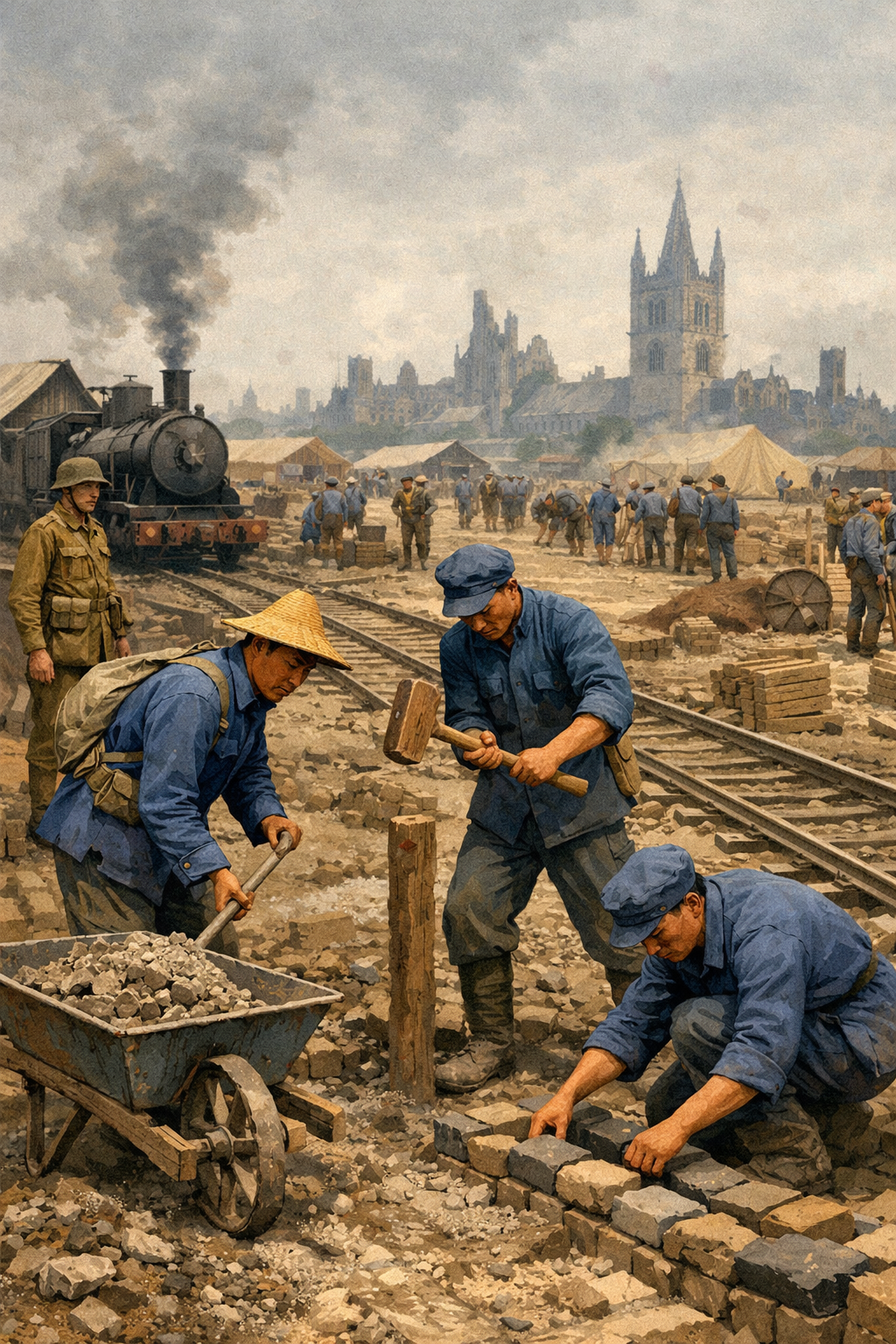
The Chinese Labour Corps was one of the largest non-combatant labour forces supporting the British Army on the Western Front. Britain recruited about 96,000 Chinese workers by August 1918, while France employed tens of thousands more. These men unloaded ships and trains, repaired roads and railways, handled stores, dug and maintained military infrastructure, and after the Armistice helped clear battlefields that remained full of wreckage, ammunition and human remains.
Their story belongs directly to Flanders Fields because the Ypres Salient depended on labour as much as infantry. Supplies had to move from railheads and depots toward the front, roads had to be repaired after shellfire, camps had to function and the devastated landscape still required years of work after the fighting ended. At Lijssenthoek Military Cemetery, current Commonwealth War Graves Commission material records 35 Chinese graves. At New Irish Farm Cemetery, seven Chinese Labour Corps men who died in 1919 lie together in a small plot. These graves make a largely invisible wartime workforce visible again.
- British Chinese Labour Corps: About 96,000 workers by August 1918
- Role: Non-combatant labour supporting supply, transport and infrastructure
- Lijssenthoek: 35 Chinese graves in current CWGC material
- New Irish Farm: Seven Chinese Labour Corps graves, all post-war period
- After the Armistice: Battlefield clearance, salvage and cemetery work continued
- Wider context: Chinese workers were part of a much larger global labour force
Why Britain recruited workers from China
By 1916 the British Army faced a manpower problem. The Western Front demanded huge numbers of men not only in infantry, artillery and engineering units but also for unloading, road work, depot labour, repair and transport. Every soldier used for heavy rear-area labour was one less man available for military duties.
China was officially neutral when British recruitment began. Men were offered paid contracts for non-combatant work overseas. Recruitment concentrated heavily in northern China, especially Shandong, where poverty and economic disruption made overseas wages attractive.
How many Chinese workers served
The National Army Museum records roughly 96,000 Chinese labourers employed by Britain by August 1918. France recruited a further large labour force of its own, which is why broader totals for Chinese workers in France often reach around 140,000 or more.
These figures should be handled carefully because British and French contracts were administered separately. The Chinese Labour Corps usually refers specifically to the British-organized force.
They were workers, not infantry
Chinese Labour Corps members were recruited for non-combatant service. Their work could still bring them close to shelling, air raids and military targets because railways, docks, depots and road systems were valuable targets.
Calling them soldiers in the ordinary infantry sense can therefore be misleading. They were military labourers under disciplined wartime organization, carrying out work essential to the army while normally remaining outside combat roles.
The work behind the Western Front
The labour force handled an enormous range of jobs. Men loaded and unloaded ammunition and food, repaired railway lines, built and maintained roads, moved stores, filled sandbags and worked in workshops and depots.
The National Army Museum summarizes their contribution clearly: without labour units maintaining supply and communications, front-line armies could not function. The industrial battlefield depended on constant human effort far behind the trench parapet.
Railways and road repair in Flanders
The Ypres region was especially demanding because shellfire and heavy traffic repeatedly destroyed roads. Rain and clay turned damaged routes into mud, while artillery batteries consumed huge quantities of ammunition.
Chinese and other labour units helped keep these connections open. Their work rarely appears in battlefield photographs because it happened behind the famous front-line locations, yet every attack depended on those repaired routes.
Working around depots and railheads
Railheads near the rear of the Salient allowed large quantities of material to be transferred from standard railways onto smaller transport systems. Labourers handled crates, shells, timber, engineering stores and food before onward movement.
The work was physically exhausting and dangerous. Ammunition dumps could explode, railways were bombed and industrial accidents occurred in an environment where safety standards were shaped by wartime urgency.
Life inside the companies
Chinese Labour Corps companies were organized under British officers and interpreters. Workers lived in camps with regulated routines and contracts, but the relationship was deeply unequal and shaped by contemporary racial attitudes.
Segregation, restrictions on movement and paternalistic control were normal features of the system. Telling the story accurately means recognizing both paid voluntary recruitment and the discriminatory structures under which the men worked.
Names and identity
Many Western records rendered Chinese names inconsistently. Transliteration systems varied, clerks wrote names phonetically and personal details could be simplified or misunderstood.
This creates challenges for modern family research. A man can appear in records under spellings that look very different from the original Chinese name, which means cemetery research often requires flexibility.
Language and interpreters
Communication was a major practical issue. Interpreters and educated Chinese staff acted between labour companies and British officers. Orders, contracts, medical treatment and discipline all depended on translation.
The need for interpreters also demonstrates that the Corps was not culturally uniform. Workers came from different districts and backgrounds and brought their own dialects, skills and expectations.
Danger did not end at the Armistice
Thousands of labourers remained in France and Belgium after 11 November 1918. The battlefields were full of unexploded shells, collapsed trenches, damaged equipment and bodies that had to be recovered and reburied.
Clearance work could be extremely dangerous. Mines and shells remained live, while the influenza pandemic and other diseases created a separate post-war threat.
Influenza and disease
The 1918 influenza pandemic affected armies and labour forces across Europe. Chinese Labour Corps graves dated 1918 and 1919 often reflect illness rather than direct enemy action.
At New Irish Farm Cemetery near Ypres, the CWGC highlights seven Chinese labourers who died in 1919, most probably during the period when influenza still swept through the post-war population.
Lijssenthoek Military Cemetery
Lijssenthoek is the strongest single site around Ypres for understanding the multinational rear area. The cemetery grew beside a vast medical complex at Remy Siding.
Current CWGC material lists 35 Chinese graves at Lijssenthoek. They sit within a cemetery containing men and workers from many parts of the world, making the global nature of the Allied war effort visible in one place.
New Irish Farm Cemetery
New Irish Farm contains seven Chinese Labour Corps graves in a small plot away from the main Cross of Sacrifice. CWGC interpretation notes that men of the Corps also carved War Graves Commission headstones for their comrades.
The location is useful because it connects post-war battlefield clearance with the creation of the memorial landscape visitors see today.
The work of carving headstones
Chinese craftsmen were among the workers involved in producing and engraving permanent war-grave headstones after the war. This creates an extraordinary connection between labour history and remembrance.
The cemeteries were not simply designed in London and magically completed. They required years of quarrying, transport, carving, gardening and construction, much of it performed by labour forces that rarely appear in the finished memorial narrative.
Other overseas labour forces
Chinese workers were part of a much wider imperial and global labour system. Indian, Egyptian, Maltese, South African and West Indian labour units also worked for the Allied armies.
The National Army Museum estimates that around 194,000 labourers from these wider groups were working in France and Flanders by the end of the war. The Western Front was therefore sustained by a workforce drawn from far beyond Europe.
Racial hierarchy and remembrance
Contemporary military administration often treated labour units through racial assumptions that affected pay, status, accommodation and the kind of work assigned to them.
Modern remembrance should neither romanticize that system nor reduce the men to victims alone. They signed contracts, earned wages, formed communities, negotiated with authority and played a measurable part in the Allied war effort.
What happened when they returned home
Most Chinese Labour Corps workers eventually returned to China, taking wages, stories and experiences of Europe with them. Their service did not produce the same public remembrance culture that developed around combat troops in Britain and the Dominions.
For decades their contribution remained marginal in Western popular histories. Recent museum work, cemetery interpretation and research have begun to restore the Corps to the wider story.
Why the Chinese Labour Corps matters in Flanders
The Corps makes the battlefield larger than the firing line. It forces us to ask who repaired the road, unloaded the ammunition, cleared the ruined village and helped build the permanent cemeteries after the war.
Once that question is asked, Flanders Fields becomes a global labour landscape rather than only a military one.
A useful route around Ypres
A labour-focused visit can combine Lijssenthoek, New Irish Farm and rear-area logistics around Poperinge with one front-line site. This shows the distance between the battlefield and the infrastructure supporting it.
The In Flanders Fields Museum can add wider imperial context, but the cemeteries provide the strongest direct evidence because the workers are named and physically present in the landscape.
Guide’s perspective
At Lijssenthoek, do not begin by saying there are Chinese graves. Begin with the hospital and railway network. Explain why thousands of people worked behind the Salient. Then find the Chinese plot. The graves make sense because the logistical system has already been explained.
How to read this story on the ground
Start with geography before adding names. Identify where the front stood, where the rear area began and how roads, canals, railways or villages connected the two. This prevents an individual story from floating free of the battlefield that shaped it.
Then add one documented person, object or contemporary source. The combination of place and person is far more memorable than a sequence of statistics.
What has changed since 1918
Flanders was rebuilt, farmed and modernised after the war. Camps disappeared, damaged roads were resurfaced and temporary buildings vanished. Many important locations now look completely ordinary.
That does not remove their historical value. Maps, cemetery locations, surviving infrastructure and archival photographs can still make the wartime landscape readable.
Why source quality matters
First World War stories are repeated in guidebooks, family traditions and online posts, often without the original source. Dramatic details should be checked before being presented as fact.
Official records, contemporary documents and reputable museum collections provide the strongest framework. Where the evidence remains uncertain, the page should say so clearly.
Planning this subject into a private battlefield day
This theme works best when it is connected to nearby military sites rather than treated as an isolated lecture. A labour story can lead into logistics, a civilian story into reconstruction, and remembrance into a grave or memorial.
Current tour pricing belongs on the live booking page. The historical copy should remain evergreen while the booking information can change independently.
Why the Corps is easy to miss on the modern battlefield
Chinese Labour Corps camps were temporary working environments, not monumental battlefield positions. Huts were dismantled, rail sidings disappeared and roads were rebuilt. Unlike a cemetery or concrete bunker, a labour camp could vanish almost completely once the war economy ended.
This makes documentary evidence especially important. Cemetery plots, company records, photographs and transport maps often preserve the history better than the modern surface landscape.
Chinese graves and headstone inscriptions
Chinese Labour Corps graves can look different from neighbouring Commonwealth military burials because Chinese characters and specific inscriptions may appear on the stones. The graves demonstrate how the Imperial War Graves Commission had to adapt a standard commemorative system to people from very different cultural backgrounds.
For visitors, reading the name, company number and date is a useful starting point. A 1919 death immediately raises a different historical question from a 1917 battlefield casualty: why was this man still in Europe after the Armistice?
Why 1919 matters
The war did not end administratively on 11 November. Battlefields had to be cleared, ammunition collected, roads restored and cemeteries created. Labour units remained because millions of tonnes of military material still occupied the former front.
That post-war phase belongs to First World War history. The men who died during clearance and influenza were casualties of the war’s aftermath even when no shell was exploding nearby.
Frequently asked questions
How many Chinese workers served under the British on the Western Front?
The National Army Museum records about 96,000 Chinese workers employed by Britain by August 1918.
Were Chinese Labour Corps members soldiers?
They served under military organization but were recruited primarily for non-combatant labour duties rather than infantry combat.
What work did they do?
They unloaded stores, repaired roads and railways, handled supplies, worked in depots and workshops, and helped clear battlefields after the Armistice.
Are Chinese Labour Corps graves found around Ypres?
Yes. Current CWGC material records 35 Chinese graves at Lijssenthoek and seven Chinese Labour Corps graves at New Irish Farm Cemetery.
Did they remain after the war ended?
Yes. Many remained into 1919 to clear battlefields, handle salvage and support reconstruction.
What is the cancellation policy for a private tour?
Cancellation is free up to 7 days before the tour.
Historical details checked against: Live Visit Flanders Fields Chinese Labour Corps page; National Army Museum: Chinese Labour Corps collections; Commonwealth War Graves Commission: Lijssenthoek Military Cemetery; Commonwealth War Graves Commission: New Irish Farm Cemetery; Imperial War Museums: First World War gallery material.
Private Flanders Fields Battlefield Tour
This story can be included in a private battlefield day from Bruges or Ypres, with the route adapted to your interests or family history.
Free cancellation up to 7 days before the tour.
Check AvailabilityWritten by Niels Declercq, private WW1 battlefield guide based in Bruges.