Stories of Remembrance · Herbert Helliwell
Following Herbert Helliwell’s Last Days in Flanders
Some families arrive in Flanders with a name carved on a memorial. Others bring photographs, letters and records that have been kept for generations. When I guided members of Herbert Helliwell’s family through the Ypres Salient, we had all of those things. What we did not have was an exact place where his life ended.
Herbert was only 21 when he was killed on 20 November 1914. He had served with the Household Cavalry from the opening weeks of the war, survived the retreat from Mons and the desperate fighting of October, and finally disappeared into the battlefields south of Ypres. More than a century later, we set out to follow his story as closely as the evidence would allow.
The Young Man from Newark
His full name was Thomas Herbert Helliwell, but the family knew him as Herbert. He was born in Newark-on-Trent on 12 February 1893, the son of Barker and Frances Helliwell. Before becoming a professional soldier, he trained and worked as a draughtsman. His education had taken him through Wesleyan Day School and Newark’s School of Science and Art. He also had a strong connection with Holy Trinity Catholic Church, where he had sung as a choirboy and later served in the sanctuary.
These are the details I always look for when researching a soldier. A service number tells us how the Army recorded a man. His family, schooling, work and faith help us understand the life he left behind.
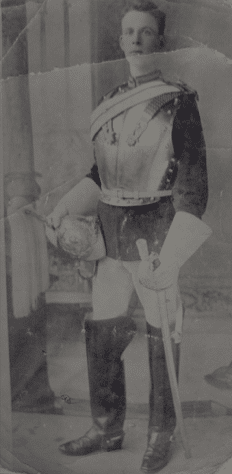
Herbert first joined the Territorial Force in 1910, serving with the 8th Nottinghamshire and Derbyshire Regiment under number 1003. In October 1912 he entered the Regular Army and joined the prestigious 1st Life Guards, receiving a new service number: 2922. A surviving photograph shows him in the ceremonial uniform of the Household Cavalry, complete with breastplate and helmet. Less than two years later, he would be fighting on foot in hastily dug trenches.
Herbert’s Own Words from the Western Front
When war broke out in August 1914, Herbert went overseas as part of the Household Cavalry Composite Regiment. In a letter dated 24 September, he told his family that he had landed at Le Havre on 17 August and first encountered German artillery fire on 24 August. Those are not details inferred from a regimental history. They are moments Herbert himself chose to describe.
By October, the regiment was fighting in Flanders. In another letter, dated 31 October, Herbert described heavy fighting on 20 October around the southern approaches to Messines. He remembered men being caught by enemy fire while digging trenches, and the fields of mangolds and turnips through which they had to move under fire.
It is one thing to read about a battle on a map. It is quite another to imagine a young man recognising ordinary crops in the middle of it. During our battlefield journey, those small details gave the landscape a personal meaning.
The Household Cavalry at Zandvoorde
Ten days after the fighting Herbert described, the Household Cavalry suffered another devastating blow at Zandvoorde on 30 October 1914. The village was heavily bombarded before German troops overran the British positions. The survivors were pushed back towards the Klein Zillebeke ridge.
The Household Cavalry Memorial at Zandvoorde helps explain what the regiment endured during the First Battle of Ypres. But historical research requires an important distinction: knowing where a regiment fought does not automatically tell us where one individual soldier stood. I could explain the action and its consequences to Herbert’s family without claiming that he personally occupied a particular trench at Zandvoorde.
Following His Final Days around Zillebeke
By 11 November, the Composite Regiment’s men had returned to their parent regiments. Herbert was again serving with the 1st Life Guards. The records place the regiment in the fighting around Zillebeke, and on 19 November it moved into advanced positions near Klein Zillebeke.
At Zillebeke Churchyard, two other 1st Life Guards officers give this part of the story a human scale: Lieutenant William Reginald Wyndham, who died on 6 November, and Second Lieutenant Howard Avenel Bligh St George, who died on 15 November. Their graves help tell the story of the losses suffered by Herbert’s regiment in the days before his death.
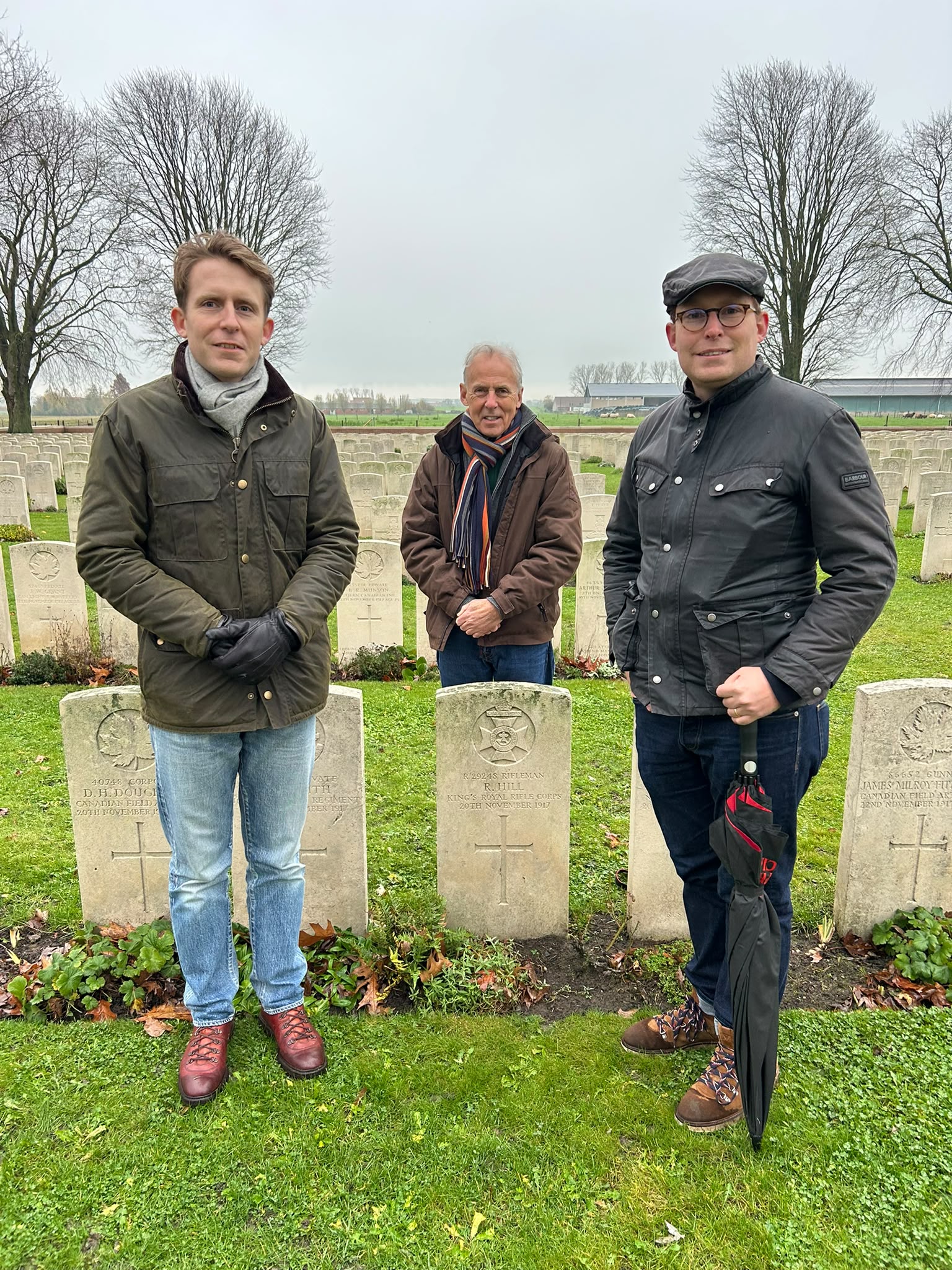
We also paused beside Renshaw Hill’s grave during the tour, another moment to remember an individual life among the many lost in the Ypres Salient.
On Friday 20 November 1914, the 1st Life Guards positions came under heavy German shellfire. The regiment’s war diary and the 7th Cavalry Brigade diary describe the bombardment and the difficulty of holding the forward trenches. In one section, men had to seek temporary shelter in neighbouring French positions before returning. We can reconstruct those movements at unit level, but the surviving papers do not tell us exactly which trench Herbert occupied.
After his death, a fellow soldier, J. Victor Bell, wrote to Herbert’s parents. In a letter later reproduced in the Newark press, Bell explained that Herbert had been killed instantly. He could not disclose the location. Even this moving account leaves us with questions: Bell’s surviving words do not establish whether he witnessed the death himself or precisely how Herbert was struck.
Two Comrades, Two Graves
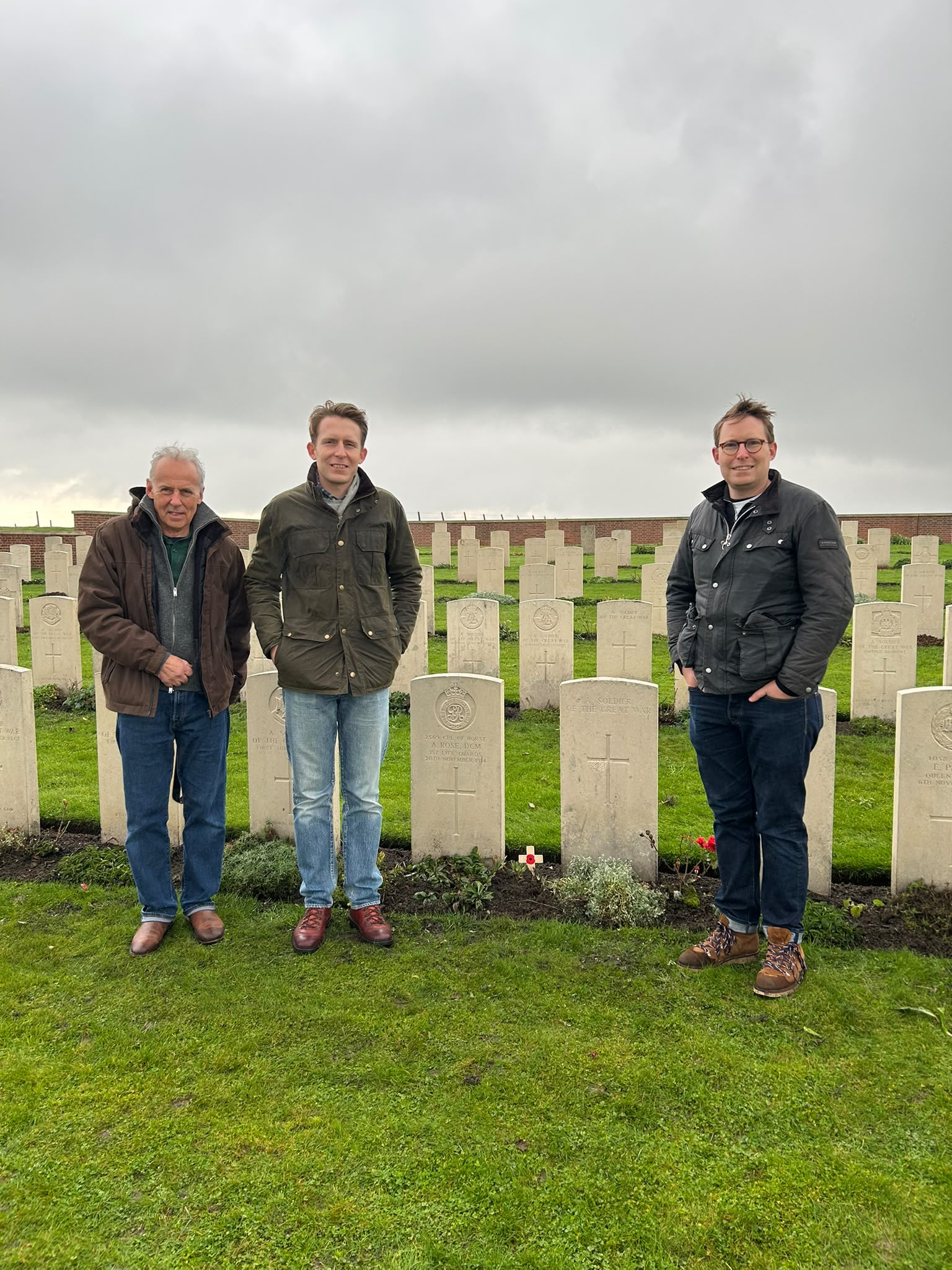
Our investigation also followed two men of the same regiment who died on 20 November: Trooper Cyril Robert Spoor and Corporal of Horse Arthur Rose, a recipient of the Distinguished Conduct Medal. Spoor is buried at Sanctuary Wood Cemetery; Rose rests at Kemmel No. 1 French Cemetery.
Both were identified during the post-war search for the missing. Their Commonwealth War Graves Commission records preserve the map references where their remains were found. Remarkably, those recorded recovery points are less than a kilometre apart. Another British soldier, still unidentified, was recorded at the same map reference as Rose.
That discovery raised a possibility worth investigating, but not a conclusion we can make. The unknown man cannot be named as Herbert without further evidence. Nor does the location where a body was recovered necessarily mark the place where that soldier fell.
For me, this is one of the most important parts of guiding a family through its history: showing what the documents really tell us, and being equally clear about what remains unknown.
A Name on the Menin Gate
Herbert has no known grave. His name is recorded on Panel 3 of the Menin Gate Memorial in Ypres, among thousands of men whose bodies were never identified or whose graves were lost.
By the end of our tour, we had followed him from his life in Newark to the early fighting of 1914, through the Household Cavalry’s battles in Flanders and into the fields around Klein Zillebeke. We could place his regiment in the landscape and trace the circumstances of its final day there. We could not honestly point to a single spot and say, “This is where Herbert fell.”
At the Last Post ceremony at the Menin Gate, the family laid a wreath in remembrance. It was a fitting conclusion to a day spent following Herbert’s story through the places where his regiment fought.
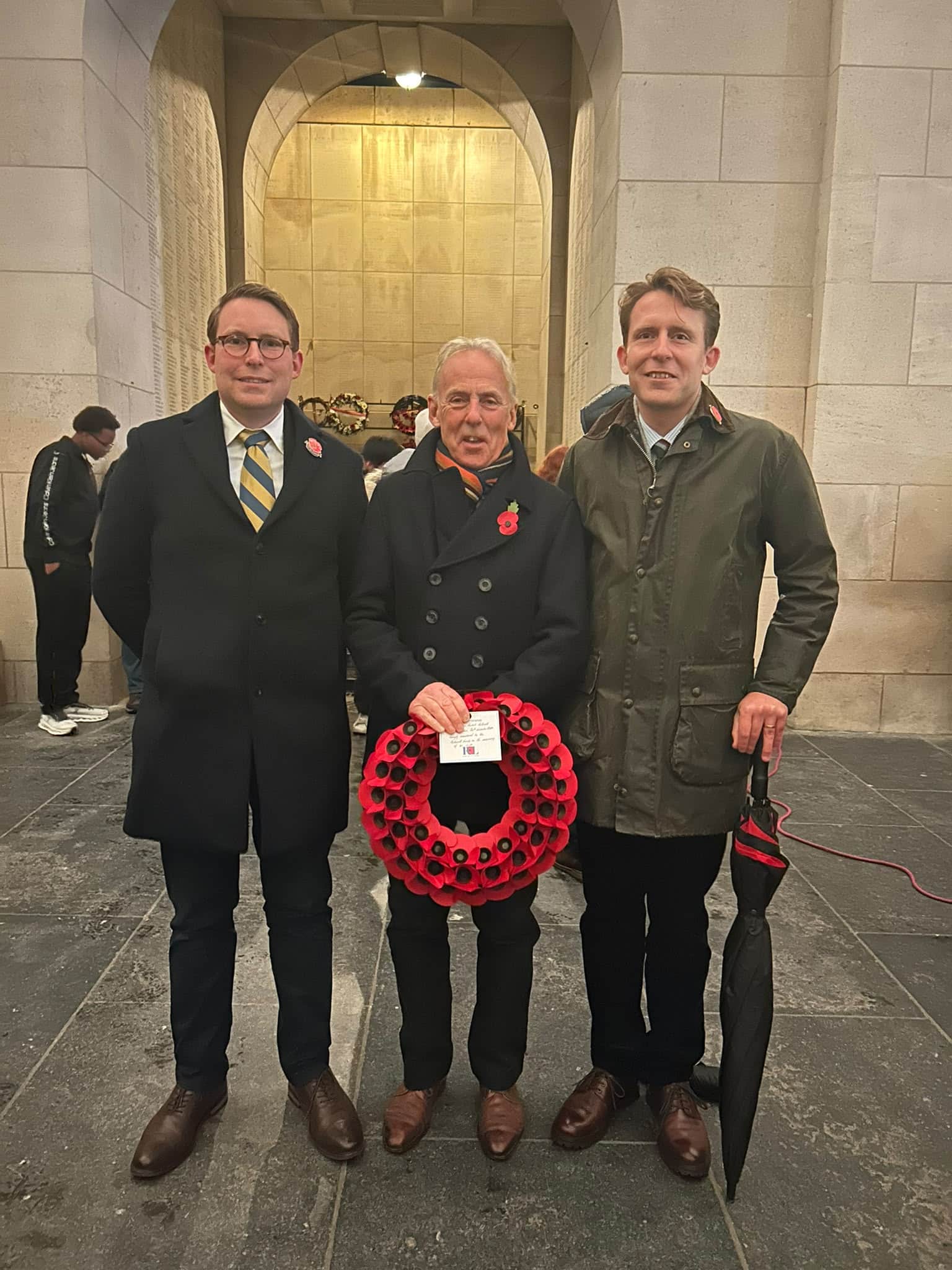
That uncertainty did not make the journey less meaningful. Herbert was no longer only a name and a date. His own letters, the recollections of those who knew him and the places connected with his service allowed us to follow the young man behind the uniform.
Private Remembrance & Family-History Battlefield Tour
Do you have a photograph, a service number, a family letter or the name of a relative who served in the First World War? I can research the surviving evidence and build a private battlefield tour around the places connected with their story.
Discover my custom battlefield tours or read more Stories of Remembrance.
Written by Niels Declercq, private First World War battlefield guide and historical researcher at Visit Flanders Fields.