Animals in WW1: Horses, Mules, Dogs and Carrier Pigeons on the Western Front

↓ Jump straight to planning a private Flanders Fields tour
Animals remained essential to First World War armies despite tanks, aircraft, machine guns and motor transport. On the Western Front, horses and mules hauled artillery, ammunition, food and ambulances. Dogs carried messages and helped locate wounded men. Carrier pigeons provided communications when telephone lines failed. By 1917 the British Army alone employed more than 368,000 horses on the Western Front, most of them working as draught or pack animals rather than cavalry mounts.
Flanders is a particularly good place to understand this because mud and shell damage repeatedly made motor transport unreliable. A lorry needed a road. A pack animal could sometimes continue when the road had disappeared. The story is therefore not primarily sentimental. Animals were part of the military transport, communications and medical systems that kept the Ypres Salient functioning. Soldiers often formed strong bonds with them, but the army also treated them as essential logistical resources that had to be purchased, fed, transported, treated and, when necessary, destroyed.
- British horses on Western Front: More than 368,000 by 1917
- Main equine role: Transport, artillery and supply rather than cavalry alone
- British pigeons: About 20,000 by 1918
- Veterinary service: Army Veterinary Corps expanded dramatically during the war
- Key Flanders challenge: Mud and destroyed roads made animal power essential
- Best interpretation: Connect animals to logistics, communications and artillery
Why horses still mattered in an industrial war
The First World War is often presented as the moment technology replaced older forms of warfare. Tanks, aircraft and motor vehicles certainly changed battle, but none could perform every transport task.
Horses could pull guns and wagons, carry ammunition and move over ground where early engines struggled. Their value actually increased as armies grew larger and consumed more supplies.
How many horses were used
The National Army Museum records that by 1917 the British Army employed more than 368,000 horses on the Western Front. The majority were draught and pack animals rather than cavalry horses.
Britain began the war with only around 25,000 army horses and had to acquire vast numbers from civilian owners and overseas markets.
Requisition in Britain
At the outbreak of war, the Army requisitioned large numbers of civilian horses. Owners received payment, but the loss of a working horse could still transform a farm, business or family.
The government had already surveyed horse populations before the war, recording the type, location and likely military usefulness of animals.
Horses from North America
Britain could not supply enough suitable animals domestically. More than 600,000 horses and mules were shipped from North America during the war according to National Army Museum research.
The Atlantic journey was dangerous. Animals suffered disease, injury and ship losses before even reaching military service.
Draught horses
Heavy draught animals pulled ammunition wagons, supply carts and artillery. Their strength made them crucial to the movement of the army.
A British 18-pounder field gun normally depended on a six-horse team. Multiply that across thousands of guns and the scale of equine logistics becomes obvious.
Pack horses and mules
Pack animals carried loads directly on their backs. They could move along narrow tracks and over broken ground where carts could not pass.
In the shell-damaged landscape around Ypres, that ability could keep ammunition and food moving when wheeled transport became stuck.
Mud and Passchendaele
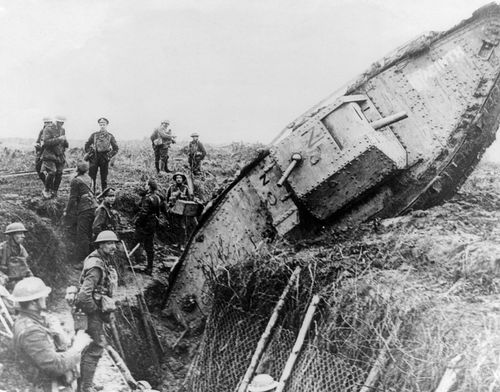
Third Ypres is one of the strongest examples of why animal power remained necessary. Rain, shellfire and heavy traffic turned roads and tracks into mud.
Photographs show horses struggling chest-deep or collapsing under loads. The image is not just one of suffering. It records a logistical system being pushed to its physical limit.
Cavalry did not disappear
Cavalry continued to perform reconnaissance, screening and mobile roles even though machine guns and trenches limited opportunities for traditional charges.
During more mobile phases in 1914 and 1918, mounted formations could again exploit open ground. The horse therefore retained both transport and tactical value.
Veterinary services
The Army Veterinary Corps expanded enormously during the war. By 1918 nearly half of Britain’s veterinary surgeons were serving with the corps.
Veterinary officers inspected animals, treated disease and injury, operated hospitals and tried to return useful horses to service. The National Army Museum records that around 80 per cent of animals treated by the corps were returned to duty.
Horse hospitals
Animal casualty systems mirrored human medical organization in some ways. Sick or wounded horses could be moved away from the front for treatment rather than automatically destroyed.
Specialized ambulances, hospitals and farriery services developed because replacing every injured animal would have been impossibly expensive.
Gas and animals
Poison gas threatened horses as well as humans. Early protection was improvised before specialized horse gas masks and protective equipment appeared.
Animals could not understand alarms or put on equipment themselves, so survival depended entirely on handlers recognizing the danger in time.
Food for the animals
Horses solved transport problems while creating another logistical requirement: they had to be fed. Fodder occupied enormous transport capacity.
Water, forage and stable or picket space had to be planned wherever large numbers of animals gathered. The transport system therefore carried supplies partly to sustain the animals that carried other supplies.
Pigeons
Carrier pigeons were valuable when shellfire cut telephone wires or runners could not move safely. Their homing instinct allowed a written message to travel from a forward unit back to its loft.
The National Army Museum records that British pigeon numbers reached about 20,000 by 1918, handled by a specialist force of around 380 men.
Why pigeons could be reliable
A pigeon did not depend on an intact wire or road. Once released, it attempted to return directly to its home loft.
That made pigeons particularly useful from isolated positions, tanks or units whose ordinary communications had failed.
Dogs
Dogs served as messengers, guard animals and in casualty work. Some were trained to locate wounded soldiers or carry small first-aid supplies.
Their use varied by army. Stories about individual dogs can become exaggerated easily, so a strong battlefield page should focus first on documented military functions.
Donkeys and mules
Mules and donkeys were valued because of strength, endurance and their ability to negotiate difficult terrain. They were especially important outside France as well, including mountain and desert campaigns.
On the Western Front, their pack role remained useful where roads disappeared under mud or shelling.
Soldiers and emotional attachment
Men often named animals, photographed them and wrote about them in letters. A horse or dog could provide continuity in an environment where human comrades disappeared quickly.
That attachment existed alongside military practicality. An animal might be loved by its handler and still be transferred, sold, injured or killed according to operational needs.
Death and disposal
Animals died from shellfire, gas, wounds, exhaustion, disease and accidents. Severely injured horses sometimes had to be destroyed quickly to prevent suffering.
The National Army Museum notes that British veterinary care was much more effective than in earlier wars, but the scale of animal casualties remained enormous.
After the Armistice
The British Army had hundreds of thousands of animals it no longer needed. Many were sold for work in Britain or abroad, while animals unfit for further service were destroyed or sold for meat.
Contemporary public concern over their fate shows how strongly wartime horses had entered civilian imagination.
What remains in Flanders
Most wartime stables, picket lines and veterinary installations disappeared. The animal story survives mainly through photographs, unit records, roads, artillery positions and the logistical geography of the battlefield.
Rather than searching for a single ‘animal memorial’ in Ypres, visitors can understand the story at gun positions, supply roads, Passchendaele terrain and rear-area sites around Poperinge.
Why this theme works well with children
Animals provide a familiar way into military history without simplifying the war. A horse pulling an 18-pounder can introduce artillery; a pigeon can introduce communications; a veterinary hospital can introduce logistics and medicine.
The key is to keep the history practical rather than turning animals into sentimental mascots detached from military function.
Guide’s perspective
At a muddy 1917 battlefield, ask how six horses pulling a gun and limber would cross the ground in front of you. That one question makes road repair, fodder, veterinary care and artillery mobility suddenly concrete.
How to read this story on the ground
Start with geography before adding names. Identify where the front stood, where the rear area began and how roads, canals, railways or villages connected the two. This prevents an individual story from floating free of the battlefield that shaped it.
Then add one documented person, object or contemporary source. The combination of place and person is far more memorable than a sequence of statistics.
What has changed since 1918
Flanders was rebuilt, farmed and modernised after the war. Camps disappeared, damaged roads were resurfaced and temporary buildings vanished. Many important locations now look completely ordinary.
That does not remove their historical value. Maps, cemetery locations, surviving infrastructure and archival photographs can still make the wartime landscape readable.
Why source quality matters
First World War stories are repeated in guidebooks, family traditions and online posts, often without the original source. Dramatic details should be checked before being presented as fact.
Official records, contemporary documents and reputable museum collections provide the strongest framework. Where the evidence remains uncertain, the page should say so clearly.
Planning this subject into a private battlefield day
This theme works best when it is connected to nearby military sites rather than treated as an isolated lecture. A labour story can lead into logistics, a civilian story into reconstruction, and remembrance into a grave or memorial.
Current tour pricing belongs on the live booking page. The historical copy should remain evergreen while the booking information can change independently.
The logistical burden of keeping horses alive
Every military horse required daily feed, water, grooming and veterinary attention. Large formations therefore needed enormous quantities of oats, hay and forage in addition to the food carried for soldiers.
This created a logistical paradox: animals made supply possible, but a significant portion of supply existed simply to sustain the animals doing the carrying.
Farriers and hoof care
Hooves were critical military equipment. A lame draught horse could immobilize a gun team or wagon, so farriers worked continuously to shoe animals and treat foot problems caused by mud, hard roads and heavy loads.
The Army Veterinary Corps established farriery schools during the war, showing how specialized animal care became part of industrial-scale military organization.
Why memorial language can become sentimental
Modern remembrance often describes animals through loyalty, innocence and sacrifice. Those themes are understandable, but they can hide the practical military reality in which animals were purchased, allocated and worked as resources.
A balanced account can acknowledge soldiers’ genuine affection while still explaining the institutional system that depended on animal labour.
Animals and the scale of modern warfare
The continued reliance on animals does not make the First World War less modern. It shows how industrial armies combined new technology with older forms of power wherever each worked best.
A battlefield full of motor lorries, field guns, telephones and aircraft could still depend on a horse team for the final few kilometres of ammunition delivery.
Frequently asked questions
How many horses did the British Army use on the Western Front?
The National Army Museum records more than 368,000 horses employed on the Western Front by 1917.
Were most war horses cavalry horses?
No. Most served as draught or pack animals moving guns, ammunition, food and other supplies.
Were pigeons used in the First World War?
Yes. British pigeon numbers reached about 20,000 by 1918 and they were used when other communications failed.
Did the army have veterinary hospitals?
Yes. The Army Veterinary Corps operated treatment and evacuation systems and returned many sick or wounded animals to service.
Can animal history be included in a Ypres battlefield tour?
Yes. It connects naturally with artillery, logistics, Passchendaele mud, transport and rear-area medical systems.
What is the cancellation policy for a private tour?
Cancellation is free up to 7 days before the tour.
Historical details checked against: Live Visit Flanders Fields animals page; National Army Museum: Horse Power in the First World War; National Army Museum: Army Horse Care in the First World War; National Army Museum: Animals in the First World War; National Army Museum: Royal Army Veterinary Corps.
Private Flanders Fields Battlefield Tour
This story can be included in a private battlefield day from Bruges or Ypres, with the route adapted to your interests or family history.
Free cancellation up to 7 days before the tour.
Check AvailabilityWritten by Niels Declercq, private WW1 battlefield guide based in Bruges.