
When a Bell in Marshchapel Still Speaks Their Names
Some stories of remembrance begin on the battlefields of Flanders. Others begin much further away, in a village church tower in England.
This one begins in Marshchapel, Lincolnshire.
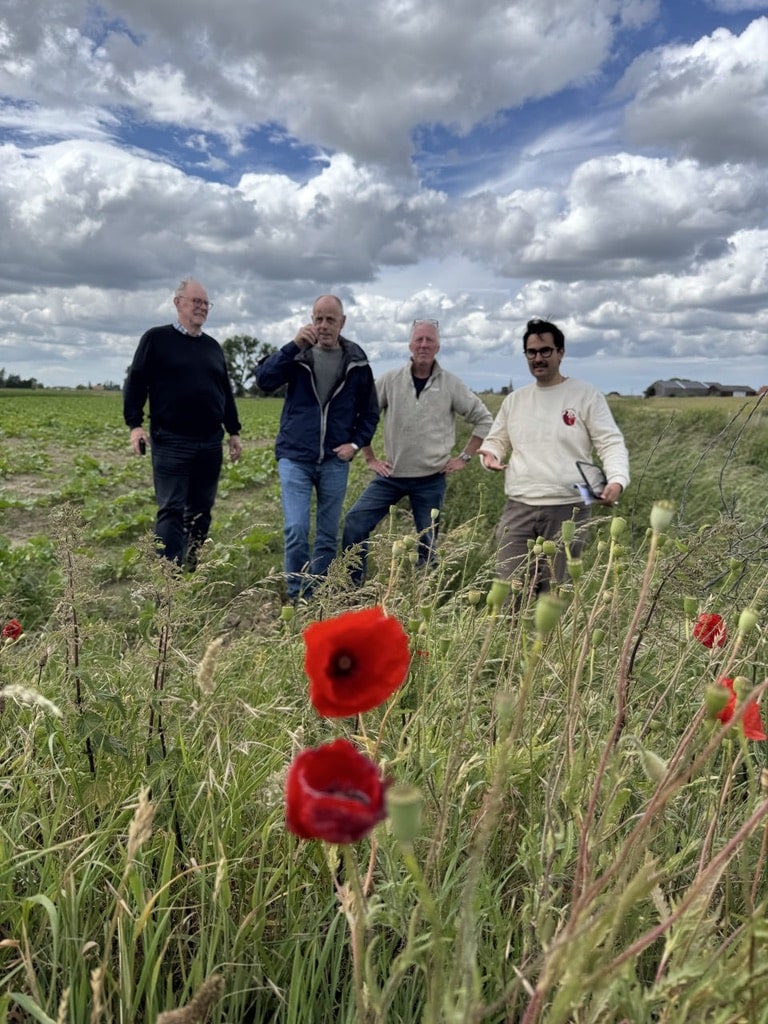
Four friends from Marshchapel recently came to Flanders with a very personal connection to the First World War. They had been involved in the restoration of the bell tower of St Mary’s Church, the village church often known locally as the “Cathedral of the Marshes.” During that restoration, old pieces of timber from the tower were saved. From that wood, they made small crosses.
Wood from a church tower is not just building material. It has held sound, weather, silence, Sunday bells, village weddings, funerals, and ordinary life. By shaping that timber into crosses, the friends carried a piece of Marshchapel to the men from that parish who never returned.
Among the names remembered in the church tower are Walter Leak and Albert Sargeant.
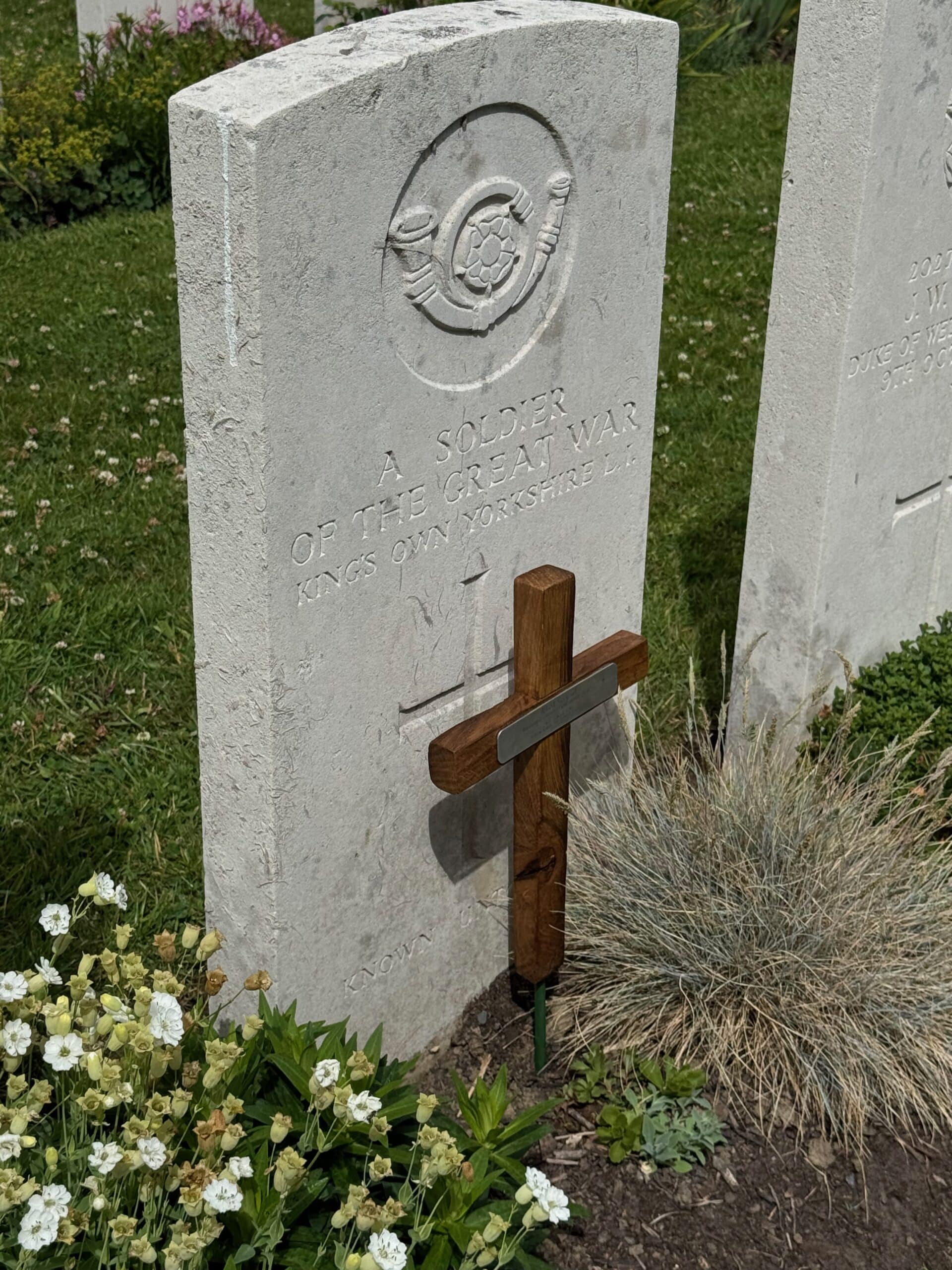
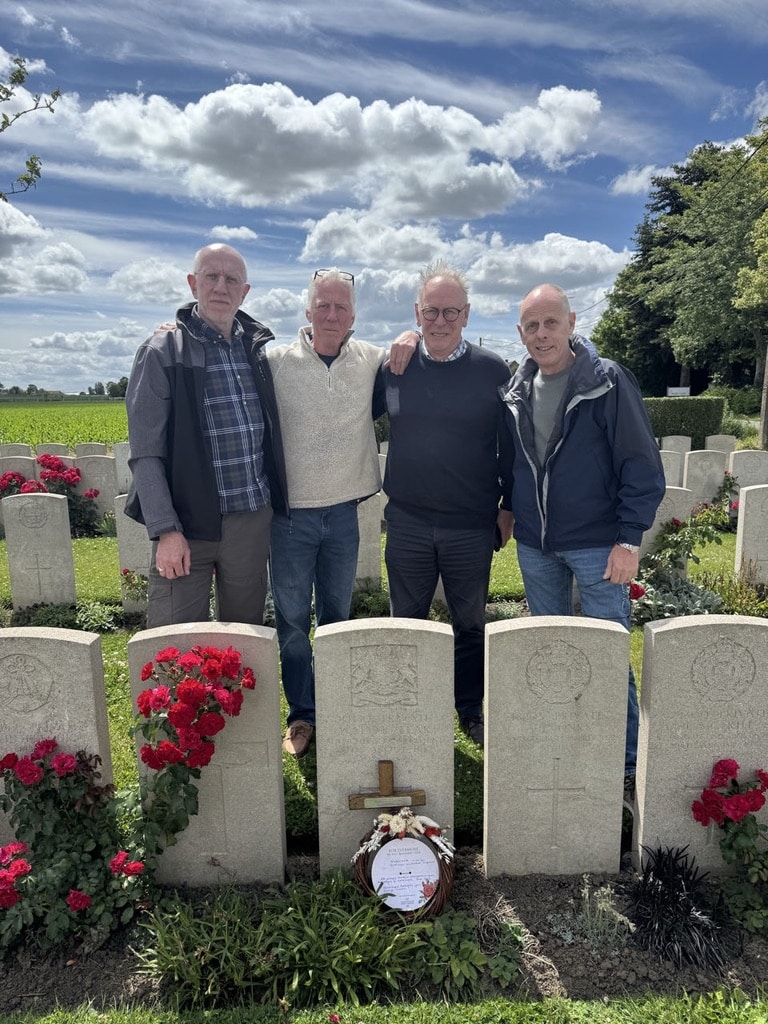
Walter Leak served with the 11th Battalion, Manchester Regiment. He died on 20 August 1917, aged 37, and is buried at Brandhoek New Military Cemetery No. 3, not far from Ypres. The CWGC records him as the son of George Keatley Leak and Mary Ann Leak of Marsh Chapel. His grave carries the inscription: “Until the day breaks and the shadows flee away.”
Albert Sargeant served with the King’s Own Yorkshire Light Infantry. He died only four days later, on 24 August 1917, aged 24. He has no known grave. His name is recorded on the Tyne Cot Memorial, panels 108 to 111. He was the son of Mr and Mrs J. Sargeant of Duckthorpe, Marshchapel, Lincolnshire.
Two men from the same small place. Two deaths in the same week. Two very different forms of remembrance in Flanders.
Walter has a grave.
Albert has a name on a wall.
That contrast is one of the hardest things to explain on the old Western Front. A grave gives the family a place. A headstone. A row. A plot. A point on a map. But a name on a memorial speaks of absence. It means the man died, but his body was never found, never identified, or could not be given a known grave.
At Brandhoek, Walter Leak rests among rows of white headstones. The cemetery is quiet, ordered, and human in scale. You can stand in front of his grave and read his name. You can see his age. You can read the words chosen by those who mourned him.
At Tyne Cot, Albert Sargeant is remembered in a different way. The memorial carries thousands of names of men missing in the Ypres Salient. Tyne Cot is vast. It can overwhelm visitors by its size alone. But the real weight is not in the number. It is in the idea that every single name once belonged to someone who had a home, parents, friends, habits, and a village that knew him.
Marshchapel remembered them too.
The church bell page records that the treble bell was recast in 1919 by Taylor’s of Loughborough. Its present inscription refers to the Great War and bears the names of men of the parish who died in the conflict, including W. Leak and A. Sergent. The inscription ends with the words: “Fear God Honour the King.”
That means their names do not only live in Belgium.
They also live in sound.
Every time that bell rings, remembrance is not silent. It moves through the village air. It crosses the churchyard. It reaches houses, lanes, fields, and families who may no longer know every story behind every name. But the names are still there.
That is why the small wooden crosses are so powerful.
They connect three places.
The church tower in Marsh Chapel.
Walter’s grave at Brandhoek.
Albert’s name at Tyne Cot.
For many visitors, the First World War can feel impossibly large. Armies, offensives, casualty lists, maps, dates. But remembrance becomes clearer when we follow one village, one family, one name, one object carried across the Channel.
A piece of wood from a church tower becomes a bridge.
It links home and battlefield.
It links those who returned with those who did not.
It links the living with the remembered.
The crosses made from Marshchapel timber do not try to explain the whole war. They do something more personal. They say: these men still belong to us.
Walter Leak and Albert Sargent were not just names in military records. They were men from a community. Their names were placed on a bell because the village needed to remember them not once, but again and again. Not only on Armistice Day. Not only in a book. Not only in stone.
In sound.
In wood.
In a journey back to Flanders.
More than a century later, four friends from Marshchapel stood where that memory led them. At Brandhoek, the story could be touched through a headstone. At Tyne Cot, it had to be found among thousands of names. Both places tell the same truth in different ways.
The war took young men from small communities and scattered their memory across Europe.
But remembrance gathers them back.
That is why battlefield visits still matter. Not because every question can be answered. Not because every detail can be recovered. But because standing there changes the distance. A name on a bell in Lincolnshire becomes a grave in Flanders. A name on a memorial becomes a person again.
Walter Leak and Albert Sargent left Marshchapel more than 100 years ago.
They did not come home.
But through the bell, through the crosses, and through those who still make the journey, Marshchapel still goes to them.
Reach out to us for more information!
No nonsense policy: Free cancellation up to 2 days.
Please reach out to us in case of any questions at info@visitflandersfields.com or contact us on Whatsapp.
The duration of our tour can fluctuate depending on traffic between the different destinations.
Ready to walk the battlefields?
Choose your private remembrance tour Private Battlefield Tours · Half-Day €500 · Full-Day €700
Book Now
Choose your private remembrance tour Private Battlefield Tours · Half-Day €500 · Full-Day €700