
Bayernwald German Trenches: How to Read a WW1 Defensive Position
↓ Jump straight to planning a private battlefield tour
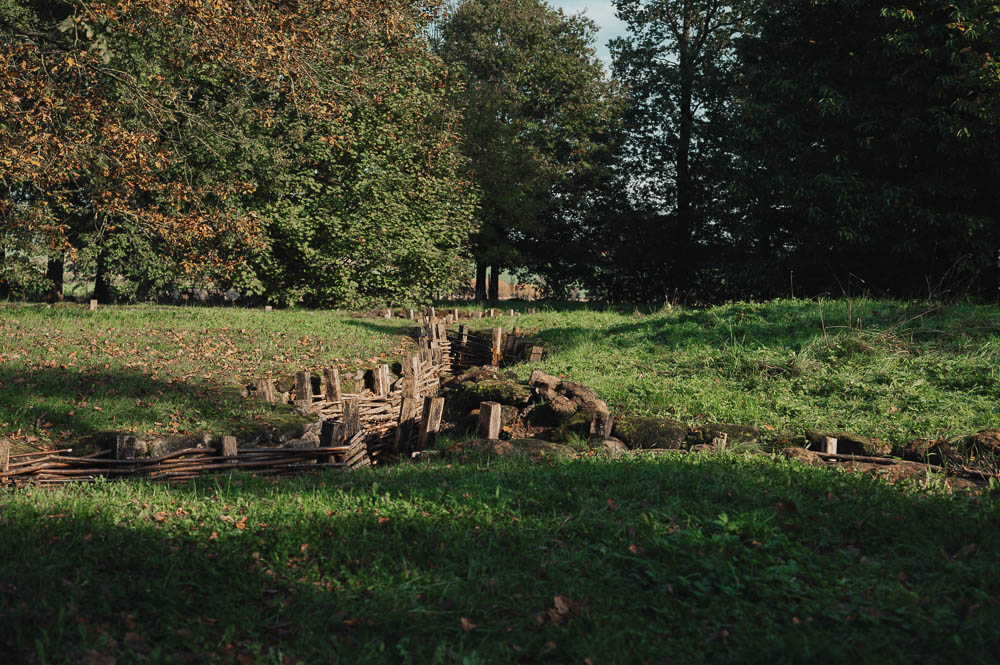
Bayernwald near Wijtschate is one of the best places in Flanders to see how the German army defended the Messines Ridge. The site preserves and reconstructs part of a German trench system with concrete bunkers, communication trenches and the remains of mine shafts. It stands on genuine battlefield ground known to the British as Croonaert Wood and to Bavarian troops as Bayernwald, or “Bavarian Wood”.
Its value is not that every timber and sandbag has remained untouched since 1917. Like any outdoor trench site, Bayernwald has been archaeologically investigated, restored and maintained. Its value lies in the authentic location, surviving concrete structures, documented trench layout and direct connection with the underground war that culminated in the Battle of Messines. It is also one of the few sites around Ypres where the German defensive experience can be explained from inside a trench rather than only through German graves.
- Location: Voormezelestraat near Wijtschate in Heuvelland
- Wartime names: Bayernwald to Bavarian troops; Croonaert Wood in British sources
- Main period: German occupation of the Messines Ridge from 1914 until the 1917 offensive
- What you see: Restored trenches, four concrete bunkers and two mine-shaft remains
- Wider context: The mining war beneath the Messines-Wytschaete Ridge
- Important caution: The site is authentic battlefield ground with restored structures; it is not untouched exactly as it stood in 1917
Why the Germans held this ground
Wijtschate sits on the Messines-Wytschaete Ridge south of Ypres. German troops captured much of the ridge during the fighting of 1914. From the higher ground they could observe Allied movement across the plain toward Ypres and the southern salient.
That observation made the ridge strategically valuable. A trench here was part of a larger system protecting high ground that the British would eventually spend years preparing to retake.
Why “Bayernwald”?
The name reflects the Bavarian units associated with the position. German armies retained strong regional identities, and Bavarian formations had their own traditions within the Imperial German Army.
The British commonly referred to the area as Croonaert Wood. Battlefield maps therefore use different names for the same ground depending on which army produced them.
A trench is a system, not a ditch
Visitors often imagine one zigzag line. Real defensive systems included front trenches, support trenches, communication trenches, shelters, observation posts, machine-gun positions and routes to the rear.
Bayernwald is useful because its restored layout lets visitors physically move through those relationships. A firing position feels different from a communication trench once you are inside it.
Why trenches zigzagged
Zigzags limited the effect of blast and enfilade fire. If an explosion occurred in one section, traverses could reduce the distance through which fragments and pressure travelled. They also prevented an enemy soldier who entered the trench from firing straight down a long corridor.
The shape was therefore practical, not decorative.
The concrete bunkers
Four concrete bunkers are part of the interpreted site. German forces made extensive use of reinforced concrete in the Ypres region. Concrete offered greater resistance to artillery than timber and earth alone.
These shelters could protect command posts, machine-gun crews and troops during bombardment. When the artillery lifted, defenders could emerge and reoccupy firing positions.
German defensive engineering
Because Germany occupied much of the ground it intended to hold, German positions often developed into substantial works. This should not be exaggerated into the cliché that every German trench was dry and comfortable while every British trench collapsed in mud. Conditions varied by sector, soil and period.
Bayernwald does, however, show the value German engineers placed on concrete, drainage and organized defensive depth.
Life in the trench
Daily trench life involved much more than combat. Soldiers repaired parapets, pumped water, carried ammunition, cleaned weapons, stood sentry, dealt with lice and rats, and tried to sleep while artillery sounded around them.
Periods of boredom could be followed instantly by violence. A quiet position might be shelled without warning or attacked by raiders. Soldiers learned to live with constant uncertainty.
Water and drainage
Flanders is naturally wet. Trenches cut into the ground can fill with water quickly if drainage fails. Duckboards, pumps and sumps were therefore essential.
The ridge around Bayernwald was better drained than some lower parts of the Ypres battlefield, but mud remained a constant problem. Preserved trenches today are maintained in ways wartime soldiers could only have envied.
The smell of a trench
One thing modern heritage sites cannot reproduce is smell. Wartime trenches combined mud, smoke, latrines, sweat, food, damp clothing, explosives and sometimes decomposing bodies.
Remembering that sensory environment prevents preserved trenches from becoming too clean in the imagination.
The underground war beneath Bayernwald
The Messines sector saw intense mining and counter-mining. German and Allied tunnellers drove galleries toward enemy positions. Listening devices and observation were used to detect underground work.
Bayernwald preserves two mine-shaft remains that help explain this hidden battlefield. A shaft was the entrance to a much larger underground network, not simply a vertical hole.
Why listening mattered
Underground, noise could kill. Tunnellers listened for picks, shovels, pumps and voices through the clay. If an enemy gallery was detected, a counter-mine could be placed to destroy it.
Men worked slowly and quietly. The psychological pressure of knowing an unseen enemy might be only metres away made tunnelling one of the strangest forms of warfare on the Western Front.
The German fear of British mining
By 1916 the German command knew that Allied tunnelling activity on the Messines front was extensive. Counter-mining destroyed or compromised some galleries, but the full mine system could not be neutralized.
The eventual explosions of 7 June 1917 confirmed the scale of the threat.
How Bayernwald fits into the 1917 battle
The Battle of Messines attacked the entire ridge, not one trench site. Nineteen mines exploded beneath German positions at 3:10 a.m. British, Australian and New Zealand infantry then advanced across a broad front.
Bayernwald lies within that larger defensive landscape. It shows the type of position the attacking armies had to overcome.
Why the site was not preserved continuously after the war
After 1918 most trench systems in Flanders disappeared. Farmers needed their land back. Timber rotted. Earthworks collapsed. Shell holes were filled and concrete structures were removed where practical.
Bayernwald survived sufficiently to be investigated and later restored as a heritage site. Archaeology helped establish trench lines and structures.
Restoration versus reconstruction
These words matter. Surviving concrete may be original. A trench alignment may be archaeologically documented. Timber revetments and sandbagging exposed to modern weather require replacement.
Calling the site “preserved” is reasonable in a heritage sense, but claiming every visible element has been untouched since 1917 is not. Accurate interpretation increases credibility.
What the site teaches that cemeteries cannot
Cemeteries explain death and remembrance. Bayernwald explains how soldiers lived and defended ground before death occurred. The scale is human: a visitor can see the distance between a shelter and the firing line.
This makes the site particularly useful for younger visitors or people new to trench warfare.
The German perspective without romanticizing it
Understanding German soldiers does not require turning the war into a story in which all political responsibility disappears. It simply means recognizing that German troops had routines, fears, families and military problems of their own.
Bayernwald gives physical evidence of how they attempted to survive Allied artillery and hold a strategically important ridge.
Compare Bayernwald with Yorkshire Trench
If you visit a British reconstructed trench such as Yorkshire Trench near Ypres, compare the layout, shelters and tactical purpose. Different sites were built in different periods and soils, so avoid treating either as a universal model.
The comparison helps visitors understand that “a WW1 trench” was never one standardized object.
Compare Bayernwald with Hill 60
Hill 60 tells the underground war through cratered ground. Bayernwald explains it through a defended trench position and mine shafts. Together they show both sides of mining warfare.
They also connect directly with the 1917 Messines operation.
Bayernwald and the Pool of Peace
The Pool of Peace is the water-filled Spanbroekmolen mine crater. Visiting Bayernwald first provides context for what those great mines were intended to destroy.
Without a defensive-site visit, the crater can become only a dramatic hole in the landscape. With Bayernwald in mind, it becomes part of a tactical system.
What to look for while walking the site
Notice line of sight. Where can a soldier see from the firing trench? Where do communication trenches lead? How far is the bunker from the front? Where would men shelter during bombardment?
Small questions make the site more instructive than simply walking from one information panel to the next.
Practical visitor information
Bayernwald is an access-controlled heritage site rather than an open cemetery. Ticketing and opening arrangements can change, so check current local information before travelling specifically to the trenches.
Wear shoes suitable for mud and uneven wooden walkways. The trenches can be damp even after dry weather.
How long to spend
Allow around 45 minutes for a serious first visit. A guide-led explanation can take longer because trench construction, mining and the German perspective all deserve separate attention.
The site combines naturally with Messines, the Pool of Peace, Hill 60 and the Island of Ireland Peace Park.
Why Bayernwald matters
Much of Flanders Fields is understood through graves and memorials built after the war. Bayernwald is different. Its core subject is the military position itself.
It reminds visitors that before the cemeteries existed, soldiers spent years designing, digging, repairing and defending systems like this one.
Fire bays, traverses and fields of fire
A firing trench was arranged so that men could use rifles and machine guns without exposing the whole position to one direct line of fire. Short trench sections, separated by traverses, broke the line into compartments. This reduced the effect of shells landing inside the trench and made it harder for attackers to fire along its entire length after entering one section.
Look outward from the reconstructed firing positions and consider the field of fire. Vegetation today is very different, so the view is not identical to wartime conditions. Even so, the relationship between the ridge and lower ground remains. German defenders were not simply sheltering in holes. Their position was designed to observe and control approaches.
Communication trenches and movement under fire
Front-line troops needed food, ammunition, water, medical evacuation and replacements. Communication trenches connected fighting positions with support areas behind them. They allowed men to move with more protection than walking openly across the surface, although they were never completely safe from shellfire.
The communication trench also explains why trench warfare required huge amounts of labour. A defensive system had to be repaired after bombardment, drained after rain and kept open despite constant traffic. Infantrymen spent a large portion of their time maintaining the battlefield rather than firing weapons.
Where did soldiers sleep?
Conditions depended on the position. Some men slept in shelters or dugouts; others rested in crowded trench bays or reserve positions. A concrete bunker offered better protection than a shallow earth shelter, but space could be cramped, damp and badly ventilated.
Sleeping was also fragmented by sentry duty, carrying parties and alarms. A soldier might be awakened for a stand-to before dawn, work through the day repairing trenches and then carry supplies after dark. The idea of a neat daily routine existed more in orders than in reality.
Why the front was busiest at night
Darkness reduced observation from enemy positions and aircraft. Much of the dangerous movement of ammunition, wiring parties and relief troops therefore took place at night. Patrols entered no-man's-land, engineers repaired obstacles and working parties carried material forward.
This changed the rhythm of trench life. Daylight could bring artillery observation and sniping; darkness brought movement and labour. Bayernwald is easiest to understand when imagined as a position that never truly slept.
Barbed wire as part of the defensive system
Wire was not simply a fence marking the front. Thick belts of barbed wire were designed to slow attackers in exposed ground, force them into predictable gaps and hold them under machine-gun and artillery fire. Before an offensive, Allied artillery attempted to cut passages through it.
At Messines, wire cutting and artillery preparation were carefully planned because intact obstacles could destroy the timing of an assault. A battalion delayed at wire might lose the protection of its creeping barrage within minutes.
What happened to wounded German soldiers here?
German medical evacuation worked through its own chain of first-aid posts and dressing stations behind the line. A wounded man might receive immediate help in a trench shelter before being carried toward a collection point and then farther to the rear.
The defensive depth visible at Bayernwald was therefore connected with roads, medical posts, ammunition dumps and artillery positions well beyond the public site. The preserved trenches are only the front edge of a much larger military system.
Archaeology and what it can recover
Battlefield archaeology can identify trench lines, bunker foundations, mine shafts and layers of wartime occupation that disappeared from the surface after 1918. Finds such as ammunition, tools, personal equipment and construction material help confirm how a position developed.
Archaeology is particularly important at restored sites because it separates documented evidence from later reconstruction. It allows interpretation to say not merely “a trench probably stood here,” but why historians believe a particular line, shelter or shaft existed.
Guide's perspective: do not begin Bayernwald by asking visitors to imagine an attack. Begin with an ordinary day. Where do you sleep? Where do you stand sentry? Where is the latrine? Where do you go when shelling starts? Once the routine makes sense, the battle makes sense too.
Frequently asked questions
Is Bayernwald an original German trench system?
It stands on authentic German battlefield ground and includes surviving structures and archaeologically documented trench lines, but exposed trench fabric has been restored and maintained.
What does Bayernwald mean?
It means 'Bavarian Wood' and reflects the Bavarian units associated with the position. British sources often called the area Croonaert Wood.
What can you see at Bayernwald?
The interpreted site includes restored trenches, four concrete bunkers and two mine-shaft remains.
How is Bayernwald connected to Messines?
It formed part of the German defensive system on the Messines-Wytschaete Ridge, which Allied forces attacked in June 1917.
Why are there mine shafts at the site?
Both sides conducted underground mining and counter-mining. The shaft remains help explain the hidden tunnel systems beneath the ridge.
How long should I allow?
Around 45 minutes is a good minimum for a first visit, especially if you want to understand trench layout and mining rather than simply walk through.

Private Flanders Fields Battlefield Tour
Use Bayernwald to understand the German side of the Messines Ridge before continuing to the mine craters, Hill 60 and the Allied memorials.
Private tour for your group. Current seasonal price and availability are shown on the tour page.
Check AvailabilityWritten by Niels Declercq, private WW1 battlefield guide based in Bruges.